
History of the 81st Tank Battalion
During September, 1943, Albert Speer assumed the leadership of all German war efforts. General Eisenhower reported Italy had signed a secret surrender five days earlier. The French began fighting against the Axis on Corsica and the Nazis wrecked the port of Naples, leaving many ships sunk.
In sports during 1944, 2:04 was the winning time for Count Fleet to win the Kentucky Derby. Detroit beat Boston to capture the Stanley Cup in Hockey and New York won 4 games to 1 over St. Louis to win the World Series. The American League beat the National League 5-3 to win the All-Star game and Wyoming defeated Georgetown to win the N.C.A.A. Championship game.
If you had a girl (and who didn't) then you were probably listening to tunes like:
Paper Doll - Mills Brothers
You'll Never Know - Dick Haymes
Velvet Moon - Harry James
There are Such Things - Tommy Dorsey
Brazil - Xavier Cugat...or
Pistol Packin' Mama - Al Dexter
You might have even taken her to see:
Casablanca with Humphrey Bogart,
Watch on the Rhine with Paul Likas, ...or
The Song of Bernadette with Jennifer Jones
That new car would have cost you the handsome sum of $1,100.00 and you were filling it up with $0.16 a gallon gas. Didn't have a new car? Well, you could probably still afford to spend $0.62 for a gallon of milk or $0.09 for a loaf of bread.
They cut off all your hair, handed you clothes that didn't fit, and fed you chow you wouldn't feed your dog. On top of that, they tried their best to work you in the ground. You suddenly found yourself in a strange place called boot camp and despite the fact there were hundreds of guys in the same boat as you, you were definately all alone. Yep, those were the good old days!

The following accounts are taken directly from the book VooDoo published by the
81st Tank Battalion Association. Copyright 1947. Charles P. DeBevoise
"It has been a pleasue to serve with the officers and men of the 81st Tank Battalion, and it has been a high privilege to lead the battalion, first in its months and years of training, and then in combat from Normandy in France to the Elbe River in Germany. Every company, every tank crew, every man, has done his job in an outstanding manner. Because of your unswerving loyalty and mutual faith, the battalion has been able to accomplish every mission assigned to it, and there were many difficult ones during the trying months of combat.
Because every man has succeeded in doing his job well, however hard, however thankless, however perilous, we have done much to further the high cause for which we fought. We were a part of the first troops in modern warfare to operate dozens, and even over a hundred miles behind the enemy's lines, and we always fought aggresively. We were the first troops to invade Germany in this Second World War, and we advanced through Germany so that at the cessation of hostilities we were the closest of the Allied troops, on the Western Front, to Berlin.
These accomplishments have not been made without considerable loss of life and blood, a loss which I feel most bitterly, even though I know the herioc and unselfish spirit of those who made that sacrifice. Let us try to be worthy to these to whom we own so much, our honored and noble dead.
This book is intended to be a precise and accurate history of the 81st Tank Battalion. The facts forming the basis of the book have been taken from the official After Action Reports, the S-3 Record of Events, Morning Reports, and the S-2 and S-3 Journals. There are a thousand interesting tales which could have been included had space permitted. The central facts are here, and perhaps the personal stories that you know, may be the better as you fit them into this framework and tell them in the years to come.
May this book help to keep alive the friendships made in these years of hard work and months of peril. I hope that in the years to come, when you turn these pages, you will again feel the warmth of our fellowship in arms, and the glow that accompanies knowledge of a difficult job well done."
Chapter I
Training
So it was on this cloudy day, 1 October 1941, that the Fifth Armored Division was born. The nucleus fro the division was formed from small cadres from the Third and Fourth Armored Divisions and was put under the command of Major General Jack W. Heard. The division then consisted of two light armored regiments, one medium regiment, three field artillery regiments, one engineer battalion, one reconnaisance battalion, and the necessary headquarters and service units.
The medium armored regiment, under command of Colonel Vernon Evans, was designated as the 81st Armored Regiment (M). The second battalion of this regiment, commanded by Lietenant Colonel Hoyt, wa the actual start of the present 81st Tank Battalion.
Armored Unit Reoganized
Camp Cooke Military Reservation (now Vandenberg Air Force Base) was constructed on a portion of the old Will Rogers Ranch near Lompoc, California. The reservation boundary included roughly 15,000 acres of land, to be used for training purposes, along several miles of the Pacific Coast line. Camp Cooke was a rather pleasant camp and was very well planned and constructed to accomodate an armored division. Very little effort had been made to beautify the camp; grass, shrubs and flowers were conspicuous in their abscence. On dry days sand storms were frequent, as the afternoons were usually windy. Often dense fog would roll in from the ocean at night and not lift until nearly noon the next day.
War with Japan
An observation post was established north of the camp at Port Petrol and an officer's observation post, west of the camp on the beach at Parisimea Point, was manned during the night to keep a constant watch for possible hostile naval action. Santa Barbara, only about sixty miles to the south, had been fired upon from the sea and it was conceivable that small marauding parties might attempt to come ashore at any point along the coast. To meet this possibility it was deemed necessary to have a battalion of tanks on the alert at all times.
Work and Play
Concurrent with the security duties was the major task of training the Battalion to form a tough and effective fighting force. New men to bring the unit up to its T/O strength arrived during the months of March and April, 1942, and were started on their thirteen weeks basic training program. Quite naturally, the greatest emphasis of the training was placed on tank warfare, but infantry drill, phusical conditioning and small arms instruction became daily routine. Small arms ranges were constructed, where the men, aftger days of "dry shooting," fired prescribed courses for qualification in the use of their personal arms. Tank driving courses were laid out whereby the potential drivers soon became proficient tank drivers.
It is said that "all work and no play makes Jack a dull boy," so all the time was not devoted to working and training. A program or organized athletics was established, with company competition in softball, basketball, et. USO shows with many prominent Hollywood stars were frequent. The post theaters operated daily to show some of the latest pictures. A rodeo was brought to the camp one Sunday, starring Leo Carrillo, riding Will Roger's famous horse. The Post Exchanges were always in operation, where is was possible to buy large cholcolate mile shakes, so thick it was almost necessary to eat them with a spoon, and of course cigarettes, candy, light drinks, magazines and many other articles were always available. Passes were issued to small quotas of men who wished to visit the small towns in the vicinity.
In July, Major LeRoy H. Anderson assumed command of the Battalion when Major Hawkins, who previously commanded the Battalion, took over the duties of S-3 at Regimental Headquarters.
Out in the Desert
At this time industry had not been completely geared to war-time production and could not produce the necessary equipment fast enough to bring all the units of the rapidly expanding army up to their required strength. Therefore the vehicular status of the division was still poor and there were not sufficient vehicles for all the men to be mounted in their proper positions. In order that those men who initially could not participate in maneuvers, in their proper mounted role, a dismounted detachment was formed at Camp Young, headquarters for the Desert Training Center. All men who could not be mounted were sent to this dismounted detachment.
Through a system of rotation, at the end of each phase of the maneuvers, it was possible to exchange groups of men from Camp Young to take part in the exercises. During the maneuvers about half of the men of the battalion spent part of their time at Camp YOung, so that all the men were able to participate in part of teh maneuvers and learn something of the tectics and technique of desert warfare.
The first two weeks in the desert were spent becoming acclimated and getting the vehicles and equipment ready for the coming exercises. The contrast between the cool damp climate of Camp Cooke and the hot dry climate of the desert was so great that during the first few days in the desert many men were hospitalized with heat exhaustion. Until the men became accustomed to the desert, a policy was established of working ten minutes and resting twenty. After about one week of taking it easy, eating at least two salt tablets per meal, always wearing helmets when in the sun, etc., the men were capable of performing a full day's work.
The temperature in the afternoons often reached as high as 137 degrees Fahrenheit, and inside the tanks it was even hotter. The iron tank hulls became so hot in the sun that they cound not be touched without gloves. One hot afternoon Sergeant Diaz of Company "D" (now Company "A") accidentally dropped an egg on the deck of his tank. Much to his surprise, the egg fried.
The Desert Maneuver exercises were so planned that it required bold and aggressive action on the part of the armored division. DUring the first few exercises the opposing forces were usually infantry. The primary enemy defenses encountered were mountain passes in which a mine field was laid and covered with anti-tank weapons, machine guns and infantrymen with small arms.
Of the tactics that were tried and developed during this maneuver period, the major accomplishment was a system of defense while in a static position in open country. Major Anderson felt that it was necessary to have a standard operating procedure so that it would be possible to have defense from an attack coming from any quarter, particularly when the Battalion was bivouaced for a night, or other long periods.
This system was based on the old covered wagon tactics in the days of the old West. A complete ring of the heaviest and least vulnerable vehicles was made, with the lighter vehicles and supplies within this ring. The old pioneers used their covered wagons for the periphery, but now medium tanks were used, each one facing away from the area. In front of each tank a machine gun from the tank was set up on a ground mount, and used as a guard post. Between each tank, and twenty-five yards behind, was a half-track, or another tank. This was another complete ring, and would be used as a second line of defense. Still further back were supply trucks and the Battalion headquarters.
In order to facilitate the placement of the vehicles the area was likened to the face of a clock, and each company, platoon, tank, and individual knew his place on the imaginary dial. When setting up the bivouac area, the Battalion Command half-track was always assumed to point to "12 o'clock" and be the center of the area. Although direct infantry support was not then used, the defensive system was sufficiently flexible to permit its use, should infantry, or other organizations be attached to the Battalion. During the night the vehicles were drawn in toward the center of the area, leaving a distance of twenty-five yards between vehicles, but in the daytime this distance was extended to 100 yards. Constant use of this bivouac soon made it possible to move into positions without undue confusion.
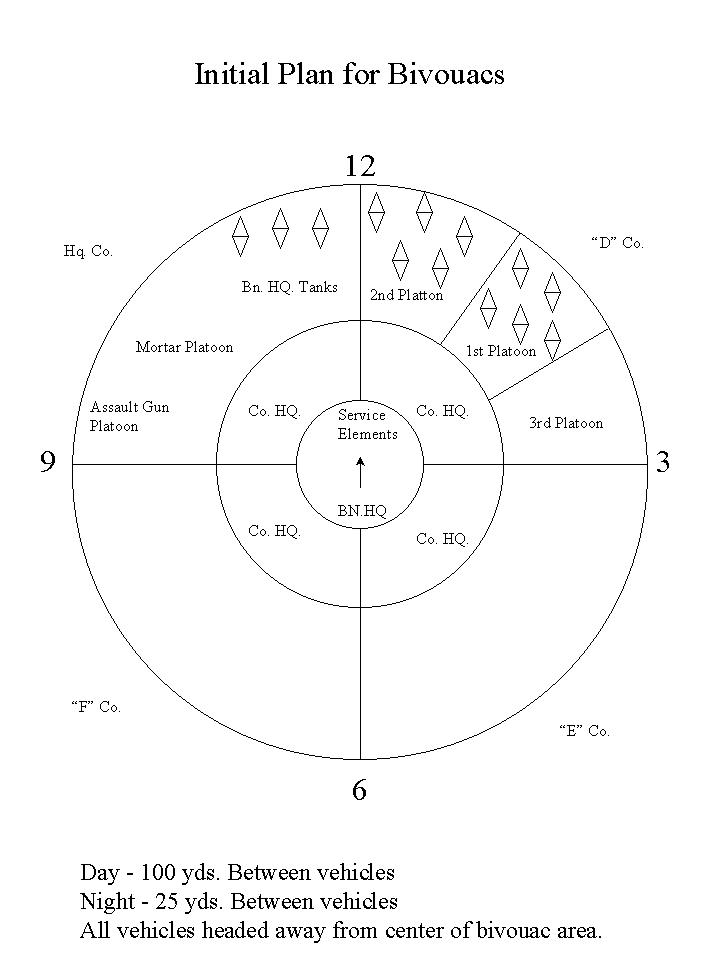 Click Here to view a
layout of the bivouac plan.
Click Here to view a
layout of the bivouac plan.Getting In Trim
Sun bathing became a daily routine, starting with a few minutes daily and gradually increasing the time until it was possible to spend several hours in the desert sun without burning. This sun bathing policy was a direct reversal of all existing rules, regulations and directives, for until this time appearing in the sun without helmet liner or shirt, or even having a sleeve rolled up, was prohibited for fear someone would be overcome with the heat.
The dust, sand, rocks and extreme heat of the desert were very hard on the vehicles. It was therefore necessary to devote a great deal of time painting and reconditioning them, in preparation for the training period wihch was to follow. Great difficulty was experienced in the painting of the vehicles due to the intense heat, which caused the paint to become powdery and rub off. Most of the painting had to be done in the evening or early morning, while there was no sunshine and it was comparatively cool.
During the stay at Needles, a fourteen-day leave and furlough schedule was started, with about fifteen per cent of the command leaving each two weeks, and continuing on through Christmas, until everyhone had an opportunity to take advantage of it. Through a change in assignments, Colonel John T. Cole assumed command of the Regiment, relieving Colonel Evans.
On 23 November 1942 the Battalion moved by rail and highway back to its permanent station at Camp Cooke with the feeling that the maneuver period had been profitably spent. The battalion was now considered, at least by its own members, to consist of skilled technicians, well versed in the proper use of its equipment of war.
Learning New Tricks
The once approved tactics of lining the tanks up and charging forward over such terrain as might be in front of the force was no longer considered as the best means of employing the great fire-power, mobility and armor protection the tank battalion now possessed. Many theories were advanced on how to best employ armor and lessons were learned about the tactics and techniques of modern warfare.
Sand tables and other training aids were devised to enable personnel to learn to manuever individual tanks and small groups of tanks to take advantage of all possible terrain features in combat operations. A great amount of time was devoted to practical work in the field, in the employment of the individiual tank, tanks sections and tank platoons, with the view of developing procedures that would reduce the enemy positions in the shortest possible time with the lowest possible loss of friendly troops. Small arms ranges, tank ranges, and combat ranges were utilized to the fullest advantage to give the men the maximum amount of experience with their weapons.
Fort Knox, Kentucky, had been designated as the home of the Armored Command (then called the Armored School), which organized many courses of instruction applicable to this relatively new unit within the Army Ground Force. Some of the most important courses were those designated to train tank mechanics, wheeled vehicles mechanics, radio operators, radio technicians, gunners, motorcyclists, clerks, tacticians, and many other specialists. The school emphasized modern methods of instruction, combined with much practical work, and therefore was very successful in accomplishing its mission.
Because of the fact that a large percentage of the personnel of a tank battalion are technicians or specialists in their particular duties, fullest advantage was taken of the opportunity to send personnel to the Armored School. Of course all personnel could not be sent to school, so those who did go became a valuable asset upon their return and were used as instructors to teach the balance of the command. This specialized training later proved its worth when the battalion engaged in its combat operations.
Chapter II
Manuevers
Soon after General Oliver assumed command, the Division received orders tomove to Tennessee to participate in the Second Army Maneuvers. Preparations were immediately made to vacate Camp Cooke, realizing that the Division would not again return to its home station. An advanced detachment from the Sixth Armored Division soon arrived to take over all vehicles and equipment which were to be left behind.
About the middle of March, 1943, the Battalion, under the command of Major Anderson entrained for the trip nearly across the continent. This move, with the entire Battalion on one train, proved to be a very interesting six day trip, with a variety of experiences. One of the baggage cars developed a hot-box and caught fire, which necessitated the transfer of baggage to another car.
At Camp Forest
After six days and nights of riding, eating, sleeping, and sightseeing in the day coaches and tourist sleepers, on a devious course across the United States, the Battalion finally arrived at the detraining point at Camp Forrest, Tullahoma, Tennessee. The arrival was in the late evening with cold and rainy weather. The tired personnel mounted waiting trucks and proceeded to their new home in the woods near McMinnville.
After spending several days getting the camp established and the pup-tent home made as comfortable as possible, the Battalion settled down in earnest to the task of drawing its vehicles and equipment, and preparing for the start of the maneuver exercises. An advanced detachment had preceeded the unit to Tennessee to sign for and check all vehicles, so they were assembled and waiting at CAmp Forrest when the balance fo the unit arrived to drive them to the bivouac area. Most of these new tanks were equipped with steel tracks and, as the Tennessee Highway Department would not permit the operation of the steel tracked tanks on their roads, it was necessary to change over to rubber tracks before the tanks could be moved to the bivouac area.
For this maneuver the Battalion was fortunate enough to receive, for the first time, it full quota of tanks and nearly all of its other vehicles. The tanks were the new M-4 series with the new and untried Ford V-8 gasoline engines. Throughout the maneuvers this new tank proved to be far superior in many respects to any tanks of the older series. The new engine was more powerful, required less maintenance and was considered by the tankers to be a great improvement over those previously used.
Ready to Move
The maneuvers, unlike the desert maneuvers, greatly emphasized proper communications and control of units of all echelons, employment of proper weapons, by-passing local strongpoints of resistance, the use of road-blocks, movement into assembly areas under cover of darkness in order to launch a surprise attack at dawn and, of course, the personal endurance of physical hardships.
The principal dangers to the tanks were considered to be anti-tank guns and mine fields. It was believed the best defense against the anti-tank guns was the great fire-power and mobility possessed by the tank battalion. The tactics taught and developed here were the immediate deployment of the force when the hostile guns were located. Part of the force would then keep the enemy under fire while the balance maneuvered to the flank to deliver the knock-out blow and overrun the enemy position as soon as the friendly fire was lifted. On some occasions the mortars were used to lay fire on difficult targets. It was generally belived that this was the best method of neutralizing hostile anti-tank guns. Although the mine fields presented a serious problem to the tankers, they were not used to any great extend and no satsfactory means were developed to overcome this hazard.
During the actual combat exercise periods, an SOP was developed and used. It was customary to have the Battalion start an advance in battalion column. As the Battalion passed important lateral roads, small detachments of tanks were left at the roads to provide security against any flank attack. Initially infantry was used (mounted) to find the way and provide security for the tanks. This proved to be very costly, as small machine gun ambush parties would soon dispose of the infantry. It then became apparent that the tanks had to take the lead, as they were not considered to be vulnerable to anything except AT guns and mines.
"Coiling" Tactics Developed
br> Major Anderson, feeling that it was not desireable to have his battalion stretched out in column formation on the road while the head of the column was engaged in a fight, devised a system of moving off the reoads into small bivouac areas. March units, usually of company size, would move into a field and set up a small defensive bivouac. This left the roads clear for the movement of required reinforcements to the front, and also provided an opportunity for the vehicles to refuel. As movement delays of several hours would frequently occur, this coiling provided the maximum amount of time for resupply and rest. It also provided a much greater security from flank and rear attacks while the head of the column was engaged.
Commanders of all echelons were kept informed by lower echelon commanders. This type of action meant that just one platoon of tanks would be "committed" in one day. In order to give the maximum amount of training to all platoons, the platoon in the leading position was changed daily. This gave each platoon at least one chance to be out in front and gain such knowledge and experience that they could in dealing with small armed parties, road-blocks, and local strong points. On some occassions it was necessary or desireable to employ more than one column. At such time the Battalion was able to make even greater advances in the course of a day and more troops could benefit from the exercises.
During the course of the exercises the weather had gotten very much more pleasant. During the first days in Tennessee it was cold and damp. Even a little snow fell. The tops of water containers would be frozen and it was jokingly stated that you had to break the ice off the top of the water in the mornings in order to shave. From this wet, muddy stage, the weather progressively got better, so that at the end of the maneuvers in late June it was very warm.
At the conclusion of the training exercises in the field, the Battalion bivouaced near Gordonsville, Tennessee, and prepared for movement to a new station. The vehicles and equipment were loaded on flat cars and once again the Battalion was on the move.
The trip farther north to Pine Camp, with its invigorating climate, was very welcome, as the days in Tennessee had become so warm that they were even oppressive and the flies in particular had multiplied. On 4 July the Battalion arrived at its new station and immediately embarked on an intensive training period. The high state of morale and training had to be maintained and the training further augmented by intensive work with weapons.
Shooting Gets Priority
After several weeks of dry practice, ranges were made available. Rifles were fired, at close range, and at long range. Pistol ranges were active. All machine gun firing courses were fired, and then fired again. Machine guns were fired from the ground, from half-tracks, and from tanks. Tanks connons were fired.
A uniform system was developed, stressing brevity and accuracy. Gunners learned to hit the targets with the first rounds. Gunners and tank commanders learned how to bracket a target. Creeping was forbidden. Rapidity of motion and accuracy of fire greatly increased. An anti- aircraft firing range was utilized. Gunners fired thousands of rounds a cal. 30 and .50 ammunition at tragets towed by an airplane. At first the bullets passed behind the towed targets but after more practice and observation the proper leads were taken, and the Battalion became proficient at firing at aircraft.
The vehicles had been exposed to very rough driving for months and it became necessary to have them in the best possible condition. A portion of each day was devoted to maintenance of the vehicles in the motor park. All vehicular equipment was cleaned, repaired and stored. The regimental maintenance company overhauled the vehicles as rapidly as possible. Each company repainted its own equipment. Tracks were changed. The rubber tracks, used in Tennessee, had worn out and were replaced with new steel tracks. The new steel tracks were very much heavier than the rubber tracks and some trouble was encountered, as track support rollers were not strong enough to hold them. Steering was more difficult. The noise increased two-fold. Cross country mobility was partially restricted but the steel tracks were servicable, which the old rubber tracks no longer were.
A program of physical conditioning was inaugurated. Daily physical conditioning in the form of calistenics became routine. Long marches around the reservation were frequent. Marches against time were made. The stadard was set at four miles in fifty minutes, marching in company formation, and with all personnel remaining in the formation.
Aircraft Recognition
During this period of intensive training, a small number of leaves and furloughs was granted. It was understood that these leaves and furloughs were to be considered the last before departing for overseas service. A fifteen-day furlough wasn't very long, especially if you lived a long way from the camp.
The War Department, in keeping close contact with modern trends in the use of armor, considered that the armored divisions were still too cumbersome. A new T/O for an armored division was approved and, on 21 September, once again the Battalion was reorganized. The 2nd Battalion of the 81st Armored Regiment was redesignated the 81st Tank Battalion. Lieutenant Colonel LeRoy H. Anderson, having been promoted just a few days before the reorganization, remained in command. The changes effected are listed in the table form below:
OLD DESIGNATION					NEW DESIGNATION

Hq. & Hq. Co., 2nd Bn.,				Hq. & Hq. Co., 81st Tank Bn.

"D" Co. (Medium Tanks)				"A" Co.

"E" Co. (Medium Tanks)				"B" Co.

"F" Co. (Meduim Tanks)				"C" Co.

		(Not formerly a part of the Battalion)

"B" Co. (Light Tanks)				"D" Co.

Service Co.     }
	             (Part of Each)		Service Co.
Maintenance Co. }

Medical Detachment (Part only)		Medical Detachment
Nearing Training's End
Headquarters Company was selected to represent the Battalion in the physical fitness test. The most difficult phase of the test was the requirement of making a company march four miles in less than fifty minutes. The company very creditably completed the march in forty-seven minutes. The performance of the company for the series of these tests was very gratifying and all the tests were passed with flying colors.
The principal test, though, and the most important, was the training status of the actual tank platoons and individiual tank crews. The fine points of crew drill were practiced. Control and precision of movemment was perfected. Tank gunnery was at its highest level and the Battalion made a fine showing in the test. It was now time to test the Battalion as a whole. A small battalion problem was drawn up but, before the test could be made, orders were received by the Division to prepare to move to Indian Town Gap Military Reservation, in Pennsylvania.
Once again the vehicles were loaded on flat cars and on 11 December, the Battalion departed for its new station.
AT 1815 on the evening of 9 December 1943, the command left Pine Camp for Indiantown Gap Military Reservation, arriving at the new station at 2000 on the 10th. The total distance traveled was 375 miles. The next few days were spent in getting situated at the new station and then the extensive training program was resumed.
Battalion, Company, and Platoon Tactics were stressed and much time was spent on the ranges. This period of training was climaxed on 10 January when the XIII Corps tested the Battalion in a Reinforced Tank Battalion Proficiency Test. In performing the operation the training the members of the command had received proved itself as well as it could short of combat.
Chapter III
Overseas
There the Battalion had the most hectic four days it had ever experienced. The personnel were examined and re-examined, inspected and re-inspected, and all equipment other than Government Issue was disposed of. Finally on 8 February 1944, the weary but "shaken down" members of the Battalion boarded a train and went to the New Jersey shore of the Hudson River.
While crossing the river in an old Pensylvania Railroad ferry to Pier 14 in Manhatten, a glimpse of the lower Hudson and of the skyline of New York City was caught. The ferry bumped softly against the end of the pier and the men, loaded with all their equipment, scrambled up and into the long dark shed. While standing in line, an old Army custom, waiting to be checked aboard, the unit met for the first time Red Cross girls serving coffee and doughnuts.
Destination Unknown
The crossing was relatively uneventful and quite smooth. Some of the men and officers were seasick, but after the first few days everyone settled down for the voyage. Aboard ship blackout was SOP. The food was apparently the standard British sea ration, and was prepared by ship's cooks, but it left much to be desired by the American palate.
Traveling in convoy, particularly along the erratic course of the northern wartime shipping lanes, required a much longer time than one would expect. After fifteen days of life on a ship, the approximately 6,000 troops on board were happy to debark when, at last, the Athlone Castle moved up the Mersey and was warped into the dock at Liverpool. At 1515 on the 25th of February, the gangplank was lowered, and the 81st Tank Battalion led the troops off the ship, along the dock to the railway station and, after again being served coffee and doughnuts by the Red Cross girls, entrained and traveled through the night to Ogborne St. Geoge.
Billets in England
After a good night's sleep on beds instead of ship's hammocks, it was much easier to set about organizing the new station. Ogborne St. George was a British installation, a sub-camp of Cheseldon Camp, and was located a few miles east of Swindon in Wiltshire. The buildings were primarily of brick and concrete construction, but several older buildings of wood frame construction had to be utilized to house everyone. There was a small theatre at the camp and Captain McPherson was able to arrange for nightly showings of the latest American movies.
February in the interior of England is not a lovely month and the unusually damp cold air caused many running noses. It was only a few days before the entire Battalion developed a case of the "ETO sniffles." The area itself was rather like a combination of American camps and the country was quite favorable for the use of tanks. The small villages throughout the area were promptly characterized as quaint but the city of Swindon was similar to any small city.
The principal task now was to draw vehicles and make them combat serviceable. The tanks, half-tracks, peeps, and trucks were issued early in March, and preparations made for their use. Through the remainder of March and the first half of April, a training program was instituted to maintain the high state of training, particularly the physical strengthening of the men's bodies, after several weeks of inactivity. New maps of the surrounding countryside were issued and the British system of map coordinates had to be learned. This proved to be a very simple and efficient system.
Preparing for the Invasion
Each company loaded what impediments it needed for housekeeping, along with some of its personnel, on trucks borrowed from Service Company and the movement started. As the trucks were unable to carry all of the personel, the remaining men rode a train to Truro, with the exception of a small detachment left at the camp. By the 16th of April CWO Isadore Napoliello and a few maintenance men from each company were the only members of the Battalion left at the Ogborne camp. They still had a very big job ahead of them to get the vehicles completely checked and serviceable.
In Cornwall it was to be the mission of the entire division, and many other troops, to set up small well camouflaged and dispersed camps to house the invasion troops just prior to their loading on vessels to cross the English Channel. Although it was a little warmer along the Cornish coast, the weather was still chilly. Pyramidal tents had been set up before the arrival of the tankers, but they had to be repitched. The tents were pitched along hedgerows, stone fences, and tree rows. Pierced planks had to be laid so that paths would not be worn in the fields to give evidence of occupancy. Slit trenches were dug for use in case of enemy air attacks. The earth that was removed had to be painted to match the rest of the scenery.
Colonel Anderson was placed in command of two "sausages" - a series of fourteen camps each, built along two main roads. Major McNamara commanded "C" sausage and Major Lord commanded "F". Each camp was built to accomodate about 200 transient troops in addition to the static personnel. Each company operated five of the camps, except "D" and Service companies. They each had four, as they had less men than the other companies. Food was prepared at each camp for the personnel within the camp. The tankers soon became very good cooks, as well as general housekeepers.
The days became warmer, so that life in the open became very pleasant. The housekeeping duties were fairly light with the camps empty. In the evenings passes were available to Truro and Redruth. The people of Chacewater opened their small clubroom so that the soldiers off duty in the evenings might have a place to go and get a "snack".
D-Day Arrives
When the radio announced 6 June 1944 as D-Day, the sausages were empty again, as they had been when the Battalion arrived. Within less than a week the camps were closed down and the Battalion, with a feeling of regret, moved overland by motor convoy to Tilshead in Wiltshire. By leaving Cornwall at 0400 on the 12th of June, the trip of 175 miles was made in one day. At 1550 the Battalion arrived at the West Downs camp at Tilshead. The few buildings that were available to the division were used by Division service troops, so that the artillery, infantry and tank battalions bivouaced in their shelter-halves in the field. A constant wind blew across the Salisbury Plains, where the Battalion camped, and at times it was most uncomfortable.
The maintenance detachment that had remained at Ogbourne St. George packed up their equipment and rejoined the Battalion. Several large tents were erected for the use of the Battalion maintenance platoon and the modifications on the vehicles continued. Every vehicle had extra racks for gasoline and water cans that had to be welded on, peeps needed machine gun mounts fastened, the tanks had to have their fenders removed, ration boxes were fastened on the half-tracks, radios were installed, tuned and tested. The equipment that had been waterproofed and packeaged had to be cleaned and properly stowed, and many other details attended to.
Ready for Combat
Through a system of rotation of battalions at the ranges, the 81st Battalion did not clear the Minehead area until 3 July. Back at the Tilshead camp, practice for combat continued. The men knew that they would be headed for France soon and were eager to be on their way. The Secretary of War, Mr. Henry D. Stimson, visited and addressed the Division on the evening of the 13th, and the knowledge that the Division would soon be on its way was confirmed.
Unit identification code words for use over the telephone and unit road signs were assigned. The 81st Tank Battalion was to be known as Voo Doo. This code word was used for the remainder of the stay in Europe, except on official documents and mail. The 15th A.I.B. was known as Von, C.C.B. as Votive and Division as Volvano.
General Oliver desired that his division should be composed of three fairly identical Combat Commands, and that each Combat Command be a complete self contained fighting force, each with its own artillery, infantry, tanks, and service personnel. The General also instituted a tactic called "married formation". In this formation the tanks and infantry would be integrated into a task force with a tanks crew and an infantry squad fighting side by side, each performing the function for which he had been trained.
A tactical exercise was planned, to be studied and then to be practiced in the field at the end of the month. Before the exercise could be held, however, the Division recieved its orders to proceed to the Dorchester Marshalling Area, and prepare for overseas shipment.
Embarkation
Loading proceeded very slowly and most of the afternoon was spent waiting in the assembly yards. As evening drew near, however, the vehicles were loading and by 1700 the Battalion was completely loaded on its ships. That night, the 24th of July, the voyage to the Continent started. The following day was spent on the decks of the ships, with no sight of land, until 2130 when the ships were 3 miles off Utah Beach, France. Landing operations were held of till daylight.
Chapter IV
Invasion
Peeps, trucks, half-tracks and tanks poured out of the ships, moved across the beaches littered with boats, vehicles, equipment and supplies, and onto the narrow, winding country roads of Normandy, France. Through this war-torn, battle scared area the Battalion drove; through St. Mere-Eglise, northwest on route N-13 through the destroyed towns of Montebourge and Valognes, southwest on route D-2 through the ruins of St. Saveur-le-Vicomte and bicouaced in the little hedge-bound fields just a few kilometers to the west of the village.
Scenes of Recent Fighting
From observations of other units which had been committed in combat, it was estimatd that the Battalion would see action against the enemy within the next four to six days. Therefore these few days were to be spent with the maximum emphasis on the final stages of training and preparation for combat. the tank-infantry teams that had been so hastily organized in England devoted considerable time to developing and practicing tactics to be used in routing the enemy from this hedgerow country.
The tanks were to lead the attack, with very close infantry support, spraying the hedges with machine gun fire and firing their tank cannons into the fence corners and other likely anti-tank or mortar positions. The infantry was then to move in and mop up the area, while the tanks secured the front and exposed flanks. It was believed that, using this plan of attack, the enemy would be either killed or forced to withdraw, with the least possible loss of friendly troops.
The Hedgerows of Normandy
A reconnaissance of the country revealed that nearly all of the fiels were surrounded with these hedges, which served the purposes of fences and were solid enough in most cases to stop a tank. In order to overcome these obstacles, hedgerow cutters, which the Ordnance fastened from German beach barricades, were fastened to the front of one tank of each platoon. The cutters were constructed to resemble large saw-teeth and proved to serve their purpose very well.
At this time very bitter fighting was in progress in the St. Lo area but, with the aid of large fleets of Allied bombers and fighter plaanes, the American troops were gradually forcing the collapse of the enemy defenses in this sector. The strategy called for an expoiting mission, led by armor, as soon as a break-through could be accomplished. The Third United States Army commanded by "Blood and Guts" Patton, which had until this time not become operational, was given the mission. Now that the Fifth Armored Division was on the European Continent, assigned to the Third Army and was ready and eager for a combat mission, it bacame the logical choice to do this exploiting job.
The Division was alerted on 1 August for movement on short notice, duffle bags and other unnecessary equipment and impediments were collected and stored under canvas in a field and guarded by members of the Division Band. Ten-in-one rations were issued for the first time and the company kitchens became non-operational. Fuel and ammunition trucks were double loaded, extra ammunition was stowed in the tanks, surplus personnel of the tank companies were put in a pool in Service Company and the Battalion was declared ready to take off on any mission that might be assigned.
Starting the Long March
The Allied forces had advanced so rapidly in the past few days that many German soldiers had not been captured, so the companies sent out patrols and soon began to bring in prisoners. The first German soldier to be taken prisoner by this Battalion came from the 177th Grenadier Regiment of the 91st Infantry Division. Other prisoners were taken from the 5th Parachute Division and the 243rd Infantry Division.
During the afternoon and evening of 5 August a section of the I & R Platoon of Headquarters Company was sent out to locate Service Company and guide it to the Battalion area. Late in the afternoon the section was ambushed by a small German outpost. Sergeant Schwartz, behind the machine gun on Lieutenant J.C. Bearden's peep, immediately opened fire and killed seven of the eight German soldiers. This was the first action on the part of the Battalion and one of the first of the Division. The recon section was then able to withdraw without suffering any casualties. Meanwhile, Service Company reached the bivouac area unaided.
That night the Luftwaffe bombed American positions several miles to the north of the Battalion area. It was a thrilling sight to watch the hostile planes drop their flares and see the long streams of tracer bullets fired at the planes, and then hear the sound of the bombs exploding as they hit the ground. A low flying plane strafed the road through the Battalion area and one round hit Corporal John K. Nunn of "C" Company, injuring him so that he had to be evacuated to the hospital. He was the first casualty of the Battalion.
Combat Commands
In order to make this Combat Command a more effective fighting force it was divided into two separate Task Forces, one under the command of the Tank Battalion Commander and the other under the command of the Infantry Battalion Commander. The Infantry Battalion gave two rifle companies to the Tank Battalion and the Tank Battalion gave one medium tank company to the Infantry Battalion. The components of each of the Task Forces, as they were to function throughout the combat operations, are shown in table form below.
Task Force Anderson				Task Force Wintermute
(Named for its C.O.)				(Named for its C.O.)

Hq. and Hq. Co., 81st Tank Bn.			Hq. and Hq. Co., 15th A.I.Bn.
"B" Co. 81st Tank Bn.}				"A" Co. 81st Tank Bn.}
"B" Co. 15th A.I.Bn. }				"A" Co. 15th A.I. Bn.}
	married						married
"C" Co. 81st Tank Bn.}				Service Co. 15th A.I.B.
"C" Co. 15th A.I.Bn. }
	married
Service Co. 81st Tank Bn.
"D" Company was retained under the direct control of Comat Command "B". The 105mm howitzer tanks were taken from the tank companies and attaached to the assault gun platoon in Headquarters Company to form a six-gun firing battery.
As can be seen from this table, TFA was about double the strength of TFW.
An infantry company and a tank company working in close support of each other were called "married companies". In this Combat Command it was the rule to have married formations whenever action was in the offing. Each tank had one squad, or a part of a squad, of infantry with it. Sometimes the infantrymen actually rode on the tanks, but more frequently traveled in their own half-tracks, a half-track following each tank. The infantry quite frequently had to dismount in order to clean out small pockets of enemy infantry and bazooka men that might have caused a serious problem to the tankers. The tankers and doughboys lived and worked together so that the smoothest of operating teams might be developed. This combination had been conceived by General Oliver but due to the short training time available in the United Kingdom was not properly tested in the field prior to combat operation.
On the Road to LeMans
"A" Company left its assembly area on 6 August with the initial mission of blocking the roads southwest of Laval, and TFA, with "B" Company leading, proceeded toward the same town with the mission of blocking the roads to the southeast. Both task forces were to move abreast on parallel routes, TFA on the left flank and TFW on the right flank, The road was such that both forces were required to use the same road on several occassions.
"A" Company, while driving through the town of Cosse-le-Vivian, received its first hostile fire. The platoon was leading, and halted the column. Lieutenant Robert Lant sent the second section of his platoon into the town, with the married infantry going in on foot. With the second section inside the town, the sounds of small arms fire could still be heard, so Lieutenant Lant brought in the remainder of the platoon. Since this was the first engagement for the platoon a great deal of ammunition was fired. At the beginning of the fight Pfc. Leroy Titsworth shot and killed the first of many German soldiers to be killed by "A" company.
The fight was soon over, with the German soldiers being either killed or forced into hiding. It was not possible to mop up the remnants of the enemy force, as the mission of cutting off Laval was not yet completed, but the remaining Germans were left disorganized and could easily be picked up by troops coming up behind. During the action the remainder of the Company by-passed the town and continued toward the east. The first platoon soon caught up with the Company, and when darkness fell the Task Force bivouaced for the night at Villers Charlemagne.
TFA advanced through the day without meeting any hostile troops, until late in the afternoon. Just as Lieutenant Leonard Keene, who was at the point for "B" Company approached a bridge across the Mayenne River, south of Laval, he saw two German cars driving along the road just ahead of him. His tank immediately opened fire and knocked out the cars. Close examination a litlle later showed that the vehicles were loaded with demolition to be used in blowing up the bridge that had just been crossed.
In a short time a group of French civilians gathered and were given the rifles, food and clothing that were found in the German cars. This soon became accepted policy in France. Most of the civilians were only too glad to join the FFI in hunting down scttered German soldiers and turning them over to the liberating forces. Then, too, they hadn't had any new shoes or clothing for several years, and were happy to get the Wehrmacht equipment.
When dusk came TFA bivouaced at an airport near Meslay-du-Maine. The third platoon of "B" Company spotted an enemy armored tank reconnaissance car at the crossroads on N-159 and N-23, and immediately took it under fire and destroyed it. While the Company road-blocks were still being put in place, a small enemy force tried to run through the positions going southeast from Laval.
Sergeant Krafka saw the force coming and got ready to shoot. He waited until he could clearly see the enemy vehicles by the light of the burning recon car, and the he ordered his gunner to open fire. Sergeant Minturn opened fire, too, and notified the rest of the Company that the hostile force was trying to get through. 1st Sergeant Wenberg organized the dismounted men and rounded up the German soldiers as they fled from their destroyed and burning vehicles.
One tank managed to slip by this platoon of Lieutenant John Jonasch's and ran down the road. Meanwhile, Lieutenant Robert McNab's first platoon further down the road was shooting up a motorcycle and a Volkswagen, which came from the opposite direction, when the German tank approached. The platoon took care of the fleeing tank, along with the motorcycle and Volkswagen.
When the shooting ended and the road-blocks reorganized, the Company commander, Captain Weldon W. Wilson, saw that none of his men had been hurt and that none of the Company's equipment had been lost. It was a different story for the Germans, though. They lost four Mark IV tanks, two Volkswagens, one motorcycle, had eleven men captured and more than twenty killed.
"D" Company also was kept busy during the day. A platoon of light tanks was attached to each task force, and the remaining platoon provided train defense for all of the CCB trains. The light tanks were used principally for "bird-dogging" down side roads that might be used as an enemy approach lane. Lieutenant Jacob Werner's third platoon had its first fight in Poille, while operating with TFW. The first tank went all of the way through the town without a shot being fired, but when the rest of the task force came up to the town the Germans cut loose. It was a fast battle and soon over. The tankers fired at all likely hostile positions in the town and, with their armored protection, easily dealt with the situation. At the end of the action Captain Kraft, who commanded the infantry in TFW, credited Sergeant Mario Rotti and his tank crew with killing twenty-seven Germans and blowing up a German ammunition truck.
The next morning, 7 August, found the tanks on the move again. It was another clear, warm day, after a starless night. The two task forces converged at Meslay-du-Maine and then "A" Company led the way southeast to Sable. There this mighty spearhead turned to the east and pushed on toward LeMans.
Welcome to "Liberators"
At the small town of Maigne a force of German fanatics armed with rifles and machine guns fired at the column from the doorways and windows of the buildings. The town was deserted by the civilians, most of whom were out in the fields or hidden in their cellars. Orders were radioed from colonel Cole to Captain William A. Boyson in the Battalion Command half-track to have the Battalion push on, assuming all reasonable losses. Lieutenant Colonel Anderson then gave his company commanders the order to run through the town with all guns firing.
Capt. Donal Hearl ordered his "A" Company tanks forward. As the column wound its way through the town the Germans started sniping, so the tanks, with their cannons and machine guns, and the half-tracks, with their machine guns and rifles, returned a very heavy volume of fire. In a few minutes the town was blazing furiously.
"A" Company passed through the town without loss and the remainder of the Battalion probed its way through the mounting debris, still firing into all likely hiding places. When an enemy machine gun was spotted in a church steeple, "C" Company's gunners immediately blew the steeple apart. At dusk, when Service Company entered the town, only smouldering ruins remained to indicate another French town touched by the finger of war. The task forces of CCB had completely destroyed it.
During the fight Private Al Sherbing, who kept a watchful eye on the radios in the Battalion Headquarters was wounded. The medical peep, while evacuating Sherbing, was hit by sniper fire and the driver killed, the first death of the Battalion. Although the peep displayed a large Red Cross flag, the sniper kept firing. Sherbing was hit again and died shortly thereafter.
Later in the night Lieutenant Benjamin Potts from "D" Company drove through Maigne in a peep. As he turned a corner in the town a German soldier fired at him from the doorway of a burned out house. Immediately another shot rang out across the street. The sniper's quick shot missed Lieutenant Potts, but the FFI soldier, who had fired from across the street, didn't miss the German. France's underground movement still maintained a careful watch. General Eisenhower in an announcement shortly before D Day had ordered the FFI to wear Tricolor brassards on the left arm and declared that the FFI was a military organization under his command. Many times in the drive across France the speed was maintained through the patriotic efforts of the FFI.
A short refueling stop was made two miles west of Noyen at 0300. Fuel trucks from Service Company made the rounds of all of the combat vehicles, dropping off the neccessary number of five-gallon gasoline cans. Vehicles were quickly refueled and checked. The empty cans were picked up by Service Company and at 0600 the march continued. On this day, the 8th of August, "C" Company took the lead, pushing on through La Suze and Arnage.
At Arnage CCA crossed in front of the column from CCB's right flank to the left flank, in order to cut off the approaches to Le Mans from the west and north. For three hours CCA went by. When the road was clear again, Lieutenant Colonel Anderson left his C.P. at Arnage and ordered "C" Company into Le Mans, while "B" company blocked the roads to the southeast. "A" Company, which had followed TFA, passed through "B" and "C" Companies and established roadblocks east of the city on highway N-157. At 1800 Lieutenant Howard Miller led his platoon of "C" Company tankers up N-23 into the city.
At the Gnome-Rhone aircraft factory and airfield located at the southern edge of this important rail termanal city, a few Germans tried to hold off the column, but Lieutenant Paul Dreisbach's mortar men knew how to deal with them. Huge bomb craters provided covered firing positions for the enemy. Infantry would not have a chance if it tried to dig out the Germans, and the big craters made it too difficult to try to use the tanks. This was the time to use the mortars from Headquarters Company. A heavy barrage was laid down using a mixture of WP and Heavy HE ammo. When the Germans tried to run the tankers machine gunned them and the infantry picked them off with their rifles.
Thirty minutes after the fight started the column was on the move again. By 2000 the city had been liberated. The 79th Infantry Division mopped up the city, but the southern suburbs yielded about 200 PW's to "C" Company. By midnight Service Company had evacuated the prisoners to the rear. All of the roadblocks were well established. At noon the following day, after a quiet but very dark night, the task forces assembled east of the city and prepared to continue the drive to Paris.
Chapter V
Pocketing the German 7th Army
At 2200 Lieutenant Colonel Anderson gathered his staff and company commanders in the blacked-out dining room of a French home and issued his orders. CCB was in division reserve and would drive north on a separate route. By midnight everything was set and the head of the column moved out. Progress was slow. The darkness made it difficult to even see the road, and following the correct route was a slow tedious task. By daybreak only a few miles had been traveled.
Artillery Unit Smashed
A few quick rounds from Corporal Louis Cannata's tank gun quieted the German gun. Lieutenant Miller's third platoon then moved out and overran the German column, killing fifty men of the Wehrmacht, and destoying nine horses, seven 105mm howitzers, two caisons, one motorcycle half-track, and one truck. Lieutenant Victor Anderson led his first platoon around to the right of the third platoon, and caught the remainder of the German artillery battalion on another road. First his platoon hit the front of the column, then the rear, and then the middle. After that it was just a matter of time before every bit of German equipment was smashed.
Colonel Escapes Capture
Lieutenant Colonel Wintermut and his S-3, Major Hurley, did not fare so well. In response to the urgent call they took off in a peep, but a German tank saw them driving down the road and fired at them. Both the officers were wounded and the peep destoyed. The German tankers stopped and gave first aid to the officers, and left them at a French farm house to be picked up by the advancing American forces.
The column continued on its way north, and as "B" Company came up to the scene of "C" Company's action, two German Mark IV tanks came into view. The first tank was duck soup for Lieutenant Jonasch. A few rounds from his .75 and the Germans deserted their tank. The second German tank, having heard the sound of firing was a little more wary. It fired at Lieutenant Jonasch, but did no damage. A few more quick rounds soon put this second tank out of commission.
At the outskirts of Bonnetable the Combat Command reassembled and everyone took this opportunity to get a bite to eat, and quickly check over the vehicles. A German truck with a big white flag drove up to one of "B" Company's road-blocks and surrendered with seven men. Other German soldiers were rounded up and sent to the division PW cage.
Sabotaging the Enemy
As the 11th of August dawned, a three-ton German truck was seen trying to travel along the same road as the task force, but in an opposite direction. Word was radioed down the column and an alert soldier threw a hand grenade through the windshield, killing the driver and stopping the truck. The column kept up the march and headed for Le Mesle.
At one "Y" road junction a peep of the I&R platoon stopped to direct the column to take the right fork. As the column went by a small German convoy came down the other branch of the "Y" and drove right up to PFC Jobe, who was standing in the road as a traffic guide. A German officer in the first car, a small sedan, stood up through the sunshine roof and threw his map case at Jobe. Jobe spun around, firing his rifle. Sergeant Romich, in the peep, brought his machine gun into action and shot up the first three sedans and a motorcycle. Then he fired at an armored half-track. Although the bullets just bounce off this vehicle, the Germans jumped out and ran away. Thirty minutes later, though, three FFI men carrying big clubs brought in eleven Germans that had escaped and turned them over to WO/JG Carl Schwab, who was inspecting the German battered equipment. In that attempt to escape from the closing trap the Germans lost one dead, three wounded and eleven others captured.
Just before reaching Le Mesle the column halted, giving the troops an opportunity to check the vehicles, eat and get washed up a bit, and then moved forward a little further to Vidai before stopping for the night. Early the next morning it continued on to Sees, where for the next three days CCB rested. part of the time at Sees was spent checking reports of civilians about the movements of German troops. Of all of the reports of German soldiers hiding around the countryside only one was found to be true, and six prisoner were taken. Later nineteen more were picked up by "C" Company road-block. The other two Combat Commands of the Division pushed onto Argantan, and the famous Argantan-Falaise gap was formed.
Strafed by Rockets
Although the Germans were pounded day and night while they tried to break out of the big pocket that had been created, some did manage to escape. In order to catch as many as possible on the south side of the Seine River, the Division again moved to the east, preparing another pocket. It was a non-stop march for ninety-five miles on back country roads paralleling N-24 to the junction of N-12, and then parallel to N-12 to stop just south of Dreux. It was a long, dusty trip. Faces burned from sun and dust, the latter containing an irritant that affected the skin.
The march was the first jump in a drive to the Seine. An infantry battle to liberate Dreux was launched, with the tankers waiting south of the city, prepared to lend fire support if it was needed. "D" Company's light tanks moved in with the infantry, providing marching machine gun and cannon fire, and secured the city while the infantry mopped up the rest of the enemy fighting in a cemetary just at the edge of the city. Dreux was liberated on the 16th of August by the 15th A.I.B. fighting as a battalion instead of the usual married formation.
Germans Driven from Seine
While striking north "B" Troop of the 85th Cavalry Reconnaissance Squadron (Mecz) worked on the right of the tanks, providing essential flank protection. Near Le Mesnel Simon they had over a hundred prisoners that they were not able to handle, so Colonel Anderson's tank was sent over to pick up the Germans and escort them to the PW enclosure. While the C.O.'s tank was thus engaged the head of the column spotted a small group of German vehicles driving toward the Seine River. Four small sedans and two trucks were all marked with Red Crosses and would have been permitted to pass if they had not fired at the column. The leading vehicles immediately shot them up, and captured five of the occupants -- SS soldiers, well armed with rifles and sub-machine guns.
The force continued on and bivouaced for the night at the outskirts of the little village of Champanard. The usual security measure were taken, and road-blocks were established. About 2300 that evening, the 18th of August, Lieutenant Coakly's road-block for "C" Company heard the sounds of a strange tank approaching from what would be the inside of the new big pocket. It was too dark for the approaching tank to be seen. Lieutenant Coakley jumped out of his tank and, standing in the middle of the roadway with a Verey pistol, fired flares in the air to give the block enough light to see what was coming.
Destroying Panthers
The German tank was destroyed, one of its crew was killed, two wounded, another taken prisoner, but the last one got away. None of the "C" Company men was hurt. When the scene was surveyed the next morning the only damage found on Lieutenant Coakley's Sherman was a jammed turret which had been hit by the gun barrel of the Panther tank, although the latter had pushed it back several feet and had burned right in front of it all night.
Later in the day five more tanks tried to get by the road-blocks of "B" Company. The Germans were feeling the pinch of the pocket they had been caught in. This time the enemy moved out in the open country with most of the firing at a range of over 1,500 yards. After the fighting had raged for an hour, all but one of the German tanks were beaten back into the pocket. This one, a Mark V had received a direct hit in the suspension system but had kept on going until put out of commission by a 75mm APC from Lieutenant McNab's platoon. As in the case of the Panther destroyed the night before, the shell had hit the gun mantle and ricocheted into the top of the tank. When the German tank was searched after the battle it was found to be from the 2nd SS Panzer Division. Three of the infantry men with the road-block were wounded by machine gun fire, the only loss in "B" Company.
Even the water point that was put out on the Seine River had its share of fighting. The equipment was hardly set up when a German tank came along the river road and drove the crew away. As soon as the tank left the water point was set up again, but was continually harried by German parties coming along the same road. In one of the fights the water crew was forced to retire and abandon their dismounted machine gun to the enemy. Tec 5 Pemberton was stopped on the way to where the water point had been by French civilians, who told him that the Germans were waiting for him around the curve of the road two hundred yards away. He turned about just in time. The Germans had tired of waiting and started shooting, but Pemberton managed to get away without even having any of the water cans punctured.
Alert for Marauders
On the morning of 22 August the force received orders to move farther up the corridor between the two rivers and cut highways N-13 and N-181. CCB was on the right flank of this drive and CCA on the left. TFA took the right flank of the Combat Command with TFW the opposite. Since the right would be the exposed flank, "D" Company was given the mission of covering it along with "B" Troop of the 85th Rcn. Word was received from CCA that two German tanks had infiltrated the bivouac area the previous night and had destroyed three of the Sherman tanks. Colonel Anderson's troops were informed of this incident to encourage sleeplessness at night, lest the same or worse befall them. This policy of alertness, particularly at night, was continued through all of the combat days.
Just prior to reaching Chaufour, a German SS prisoner was taken who stated that there were 200 SS troops dug-in in front of TFA, with orders to hold off the American advance at any and all costs. By now this was a common report from prisoners. If it had been true in half the cases reported the task forces would never have reached Le Mans.
Near the small town of Villez-sous-Bailleul, a couple of miles from the small city of Vernon, the force stopped to install road-blocks on the first of the highways that had to be cut. While the remainder of the troops took this moment to cook a quick meal, seven German planes appeared in the sky but were not immediately recognized as hostile aircraft. Since airplanes were a very interesting subject, most of the troops were staring at the sky when the first plane, then the second, and then the rest in their turn peeled off and came in for a strafing run. Everyone ducked for cover under vehicles but, quickly recovering from their surprise at the unexpected attack, started firing machine guns and rifles at the enemy planes, driving them off after only a few bombs had been dropped. One of the planes was hit in a vital spot, crashing beyond the tail of the column. Fortunately only five men were hit in this attack and no equipment was destroyed.
Attacked from Hiding
The column promptly opened fire at all suspected targets. The assault guns fired into the general area where the German soldiers had been seen, and where the AT fire came from. It soon became obvious that enemny soldiers were hiding under the grain shocks in the next field and that there were two German tanks in a defiladed position, shelling the column. The artillery fire soon caused the Germans to withdraw and the hastily summoned air support caught the enemy tanks on the road and destroyed them by strafing.
Colonel Anderson ordered "C" Company to go through the fields and clean out the Germans. First the town of Villez-sous-baileul was destroyed by tank fire, then "C" Company went around the right of the town, firing cannons and machine guns at the wheat shocks. Tank commanders dropped grenades at the sides of their tanks into the enemy's fox-holes. The infantry with their mounted machine guns sprayed the wheat shocks under which the Germans had dug their holes, and off those that tried to run. One German soldier stood up with a pistol in his hand and tried to stop a Sherman. He fired at the tank as it kept rolling toward him and didn't move until it ran over him.
When TFA reassembled on the other side of the town night had fallen and Colonel Anderson decided to bivouac in a tight formation, after considering that there might be other enemy fanatics in the area. Going on might mean running into a serious ambush. It had been a bad day for the tankers. First Sergeant Wenberg of "B" Company was killed, as was S/Sgt. Cole of the same company and several other of the tanker's comrades. The Germans had suffered, too, as during the next two days French civilians counted more than 200 dead SS men under the grain shocks.
About 0200 six rockets fell in the area but otherwise the night was quiet and on the morning of 23 August the force moved forward again to complete its mission. The next road was cut, road- blocks were put out and for the rest of the day the forces rested as best they could in the rain that had started to fall. A section of the I&R platoon drove down to the Seine River to check a report of two German tanks in the area and got into a scrap with hostile troops defending a dam. An enemy mortar round made a direct hit on one of the peeps and destroyed it, but the section did not suffer any casualities. The German force was too large for the section to handle and after killing several of the enemy the section was forced to withdraw. The German tanks were not located.
Mission Completed
While the Battalion was in this area, only 30 miles from Paris, the city was liberated. Even though the men had not been in the action in liberating the capital of France, there was a possibility that CCB would parade through the city and plans were made for this welcome detail. Instead of parading, however, orders were received to proceed to Paris and then without delay strike out for the Belgian border near Conde. These new orders involved a change in assignment from the Third Army to the First Army. In mid-morning on 30 August the tanks rolled forward again under the command of the First Army on the next step in the liberation of France.
Chapter VI
On to Germany
Word had been received from reconnaissance aircraft that a small flak gun was located near the Chantilly race track. Just as Captain Wilson's leading tanks approached the race track, they caught the self-propelled AA gun moving out. A few quick bursts with the tank machine guns destroyed the SP, 4-gun 20mm AAA, plus a small ammo truck and a staff car. Three Germans were killed but the rest got away.
Over sixty miles had been covered during the day and, as a light drizzle fell, the vehicles pulled into the race track and bivouaced. After a dark, damp night, the tanks moved forward toward Creil, the following morning. Lieutenant Miller, leading TFA, was fired upon by a 20mm gun near the large airport at the edge of Creil. His tank soon dealt with the German gun and then a small German tank.
Seeking a Crossing
When daylight approached the next morning, 1 September, the tankers heard a loud explosion from inside the city of Compeigne and even though they were able to push on past the German 88, they knew that it was too late now, The bridge here had been destroyed, too. Troops from the 28th Infantry Division had tried to capture the bridge under cover of darkness, but just as they neared the bridge the Germans blew it. That morning Sergeant Lewis went over to see the effectiveness of his markmanship of the previous night, and looked among the papers that the motocyclist had carried. There in a dispatch case he found German orders to the troops at Compeigne -- directing that the bridge be left intact, and not to be destroyed under any circumstances. Sergeant Lewis' only comment was "C'est la guerre".
Bridgehead Secured
The advance continued but once again the bridges across the Somme River west of Ham were destroyed. A crossing was made over the one remaining bridge at Ham, then the race continued through Roisel. Air reconnaissance reported a large concentraion of tanks southwest of Cambrai and it looked as though there would be a battle in a few hours. The tactical air force took over this threat, though, and completely destroyed this tank concentration. Cambrai was by-passed thirty miles to the east through the town of Carnieres. "A" Company, driving on the right flank, caught a German hourse drawn artillery battalion from the road and completely destroyed it. Lieutenant Hitchcock had his hands full for a few minutes when bedlam broke loose. German soldiers tried to run instead of surrendering and his platoon kept picking them off. The march continued around the west of Valenciennes and, still on secondary roads, around the west of Conde to the Belgian border at Peruwelz.
Into Belgium
Having cleard a way to Belgium, the Division was then directed to drive to Givron, ninety miles away to the southeast. Service Company refueled the vehicles in the force and since the 95th F. A. was short of gasoline refueled them, too. It was going to be a long trip for the amount of gas on hand. Early in the morning of the 4th of September the tanks rolled on their way again, through Conde, Valenciennes, southeast to le-Cateau, then Guise, Vervins, to Givron, a small town near Chaumont. Some of the tanks fell out of the column a few miles before they reached the new bivouac area. There hadn't been enough gasoline to make the trip. Service Company located a gasoline dump 125 miles away and brought up more fuel, and once again the tanks were ready to roll.
After one night was spent at Givron, completing preparations, Combat Command "B" continued the drive toward Germany. The Meuse River was crossed near Sedan, a town of World War I fame, and as night fell the tankers bivouaced at Douzy, The march continued across the southeastern tip of Belgium, then across the Grand Dutchy of Luxembourg, to the German border. While CCA liberated the city of Luxembourg and escorted the Prince of Luxembourt to his home, CCB drove to the north of the city and at 1815 on 11 September, Lieutenant Hank Plass led his light tank platoon into Germany. The platoon drove several miles into the Seigfried Line, around the pill-boxes, and found them all empty. Then with a part of Troop "B" of the 85th Rcn, the platoon returned to the CP near Michelau, Luxembourg.
At the Seigried Line
After two days of harrassing the Germans there was a very noticeable force in the enemy line. The pill-boxes were no longer empty. At night the hostile soldiers would infiltrate into Luxembourg and terrorize some of the small towns near the border. At Stalzemburg the married "B" Companies had to dig out a company of infiltrating Germans. This was accomplished without loss to the force, while the Germans suffered about fifty dead and four captured. These were not very good troops, being from a Fortress Battalion and part limited service forces of the Wehrmacht.
On the evening of the 15th of September CCB was directed to enter Germany from Diekirch, through the German town of Wallendorf, and continue on to Bitburg behind CCR. CCR had run into trouble as they neared Bitburg, so the 81st tankers, after driving through the destroyed town of Wallendorf on 16 September, stopped at Hommerdingen for the night. As part of the defenses of the Siegfried Lined consisted of mobile troops capable of being moved to the scene of a threat in a hurry, it was not long before the Wehrmacht troops started to infiltrate. Artillery fire fell lightly in the area. The next morning TFA Headqaurters and Headquarters Company, moved to the side of Hill 375 between Neidersgegen and Ammeldingen.
From this point it was possible to see the towns of Neidersgegen, Hommerdingen, Crutchen, and Biesdorf. "C" Company worked over the area to the northwest of Hommerdingen, with the assault gun platoon giving fire support. The first and second platoons of "B" Company stayed at Hommerdingen to protect the rear of CCR and the supporing artillery battalions. Lieutenant Keene's third platoon drove to the east of Wallendorf and started to destroy the pill-boxes that had been captured. During the afternoon five pill-boxes were destroyed and the platoon bivouaced for the night near Wallendorf.
New "Secret Weapon"
The assault gun platoon, as well as the mortar platoon, continued to lend fire support to "C" Company and the attached tank destroyer platoon. By 1700 forty prosoners were taken but the operation had to be halted as the air became very foggy, and visibility was cut down. "D" Company returned from its mission of clearing the small woods southeast of Huttingen, where they destroyed three machine guns and captured a prisoner. TFA settled down for the night on the edge of this hill, except for "B" Company, which stayed out where they had been fighting during the day.
Destroying Pill-Boxes
TFW, which had initially held Neidersgegen, moved northward about two kilometers toward Huttingen. German soldiers kept infiltrating through the woods and there was an almost constant sound of small arms firing. About 1500 in the afternoon a bit of artillery fire fell in the area occupied by the headquarters but did no damage. One platoon of "D" Company was sent down to guard the Wallendorf bridge, as it was the only route into Germany for running supplies. another platoon stayed with Service company to protect it from any infiltrating Germans. The last platoon was retained by CCB Headquarters for headquarters protection. When night came "A" Company remained out near Huttingen, "B" Company remained at Biesdorf and the rest of the force reassembled on the side of Hill 375.
The task of destoying pill-boxes continued next morning. "C" Company went out to the northwest again but found that the Germans had infiltrated and were now hiding around the destoyed fortifications. The enemy had brought up a few tanks and forced "C" Company to discontinue its task. Artillery fell in the old bivouac area and became more intense. Several vehicles were hit and destroyed. The Battalion was forced to look for another area.
The S-3, Major Francis A. McNamara, sent one platoon of "B" Company, 628th TD, back into Luxembourg to face into Germany and cover the approach lane from the north of Hill 375, being sure of a good field of fire across the Our River. "A" Company, withdrawing back to Neidersgegen, had found the town occupied by German soldiers. One TD was driven up on top of Hill 375 and poured direct fire into the town of Niedersgegen, giving support to TFW. Lieutenant Jack Dennis set up his forward observer's post on top of the same hill and turned his platoon's guns on infantry and a German artillery battery that was observed in action.
Headquarters Moved
This new position gave a commanding view of the area all around the hill and out toward the German forces to the east in particular. The mortars were able to give fire support in any direction at a moment's notice. A platoon of infantry from the married "C" Companies established a road-block at Ammeldingen. Another platoon of the same companies outposted the new bivouac area, while the third continued to assault fortifications. "A" Company, with orders to keep Neidersgegen clear, fought a determined enemy that apparently had the same orders. The battle raged intermittently for the remainder of the day. "B" Company fought to clear Biesdorf again and were counter-attacked after a platoon had cleared the town, losing three tanks. Captain Wilson having been wounded and evacuated, Lieutenant Jonasch assembled the company at a new area just southeast of Neidersgegen.
CCR had repulsed several strong counter-attacks and were constantly under heavy artillery fire. The enemy kept pushing more and more men and materiel into the battle, although he was sustaining unreasonable losses. Even though the enemy was not making any progress, CCR was taking a terrifc pounding, so they were ordered to recross the Our River back into Luxembourg under the cover of darkness on the night of 19 September. For the move out, TFW and "B" Company were to cover the route of march so that CCR would be able to leave the area without suffering from a flank attack. The withdrawal to Luxembourg was completed successfully and after CCR had cleared both "A" and "B" Companies re-assembled southwest of Neidersgegen. Artillery fire had lifted for about a half an hour late in the afternoon, when several P-47 planes were in the area giving direct support to CCR, but as soon as the planes left the artillery fire resumed and continued to pour into the area all night.
Enemy Fire Increases
Neidersgegen was lost to the enemy and when "B" Company tried to recapture the town they were thrown back with the loss of two tanks. On this day there were approximately seven battalions of artillery shelling TFA and the Wallendorf bridge. Even though the surrounding terrain was under continual observation and many of the enemy positions were spotted and taken under counter-battery fire, the Germans had enough artillery fire to still keep up their intense fire into the area. In order to preserve the unarmored vehicles, Service Company was sent back to Luxembourg early in the morning. they bivouaced west of Mostroff. "C" Company's road-block at Ammeldingen was surrounded by enemy troops, and a section of "B" Company's tanks ran down to the town to relieve it. After over forty Germans had been killed by the tankers, the block was reorganized to hold the town. A medical soldier, PFC Fink, driving to Ammeldingen to pick up a wounded man was captured by German soldiers before he had gone three hundred yards. His captors forced him to pick up their own casualties and them turned him loose to bring the wounded Germans back to the Task Force aid station.
Gradually the ring around the hill became tighter. "A" Company cleared the road to Luxembourg and then came back into Germany, taking up a position near the outskirts of Wallendorf to prevent any attack on the bridge. It was necessary to be on the alert continually to keep the Germans from walking right into the bivouac area.
Pounded by Artillery
"D" Company, which kept watch on the southeastern edge of the area, received its share of the artillery pounding. Several times each day the company would sally forth and clear up the thousand yards of open country to its front, digging the Germans out of the destroyed pill-boxes that they had started to use for shelter.
Finally night fell and the entire TFA assembled in its little saucer-shaped holow on Hill 375 in a tight formation, prepared to spend another night under the constant pounding of the enemy. The artillery fire lifted slightly, but a heavy fog rolled in, making it impossible to see anything. During the night a German platoon managed to infiltrate through a battalion of infantry from the 28th Infantry Division and blew up the bridge at Wallendorf.
Service Company, which was forced to use half-tracks borrowed from the married infantry companies to haul in ammunition, fuel and rations, carried this supply function under the cover of darkness. It was not possible to evacuate casualties until the situation at Wallendorf was cleared, so the wounded remained at the Combat Command collecting point at the western base of Hill 375, near Hosdorf.
Here They Come
As the day grew older the hostile artillery fire grew in intensity. The fire was being felt. Headqaurters company lost seven men killed and ten more wounded. "D" Company continued to make short sallies forward to keep the Germans from getting close and destroyed four machine guns and captured twenty prisones. They, too, were receiving heavy fire at the CCB CP, and the men continued to be killed and wounded. TFA, in its tight defensive postion, drove off repeated and determined enemy attacks. At last the Germans brought up fifteen tanks, preparing to launch another attack from Neidersgegen.
Morale continued at its high level, although everyone wanted to move. The force felt that it could still press the attack forward if ordered to do so, but a move in any direction would be welcome in order to escape from the heavy artillery fire. By now the Germans had moved an Air Force infantry division into Biesdorf, along with elements of five other divisions, a regiment of medium field artillery and five battalions of assorted artillery. A tank brigade had been badly beaten by CCR but the remnants were still thrown into the fight to hurl the Americans from the German soil.
The weather gradually got better and by mid-afternoon of this 21st day of September the P-38s and P-47s were able to fly. The pilots reported more targets than they could possibly handle but they went to work strafing infantry and artillery positions in woods, pounding the German CP at Biesdorf and hitting the railroad that was bringing in more men and guns. An urgent call to the planes put them on the hostile tanks that had just started the attack from Neidersgegen. Before the Germans could close in, the fighter pilots were able to completely destroy one of the tanks and disable the other fourteen, so that the attack was broken just as it started.
As the afternoon passed the planes had to return to their bases and the German artillery again opened up on the Battalion area. "B" Company killed a German forward observer from one of the batteries on top of Hill 375 and captured his maps. From a quick look at the German's map it was possible to find the locations of several of the German batteries. They were immediately given the attention by the 71st FA. Once more the Germans closed in but hastily called artillery fire again stopped the attack--only fifty yards in front of task force positions.
Withdrawal into Luxembourg
At last the time came. "B" Company led the way and the usual formation followed, with the Task Force commander, Colonel anderson, in his tank, the last vehicle to leave. As the column wound its way toward the border the Germans fired several green signal flares. A captured document had stated that green was to be the German signal for another attack, but in this case the Germans did not attack.
The engineer vehicles in CCB had been spread out through the column in order that they might have the protection of the tanks. As the first large bridge truck reached the river at Wallendorf, and started across, it got stuck in a hole. The ford was effectively blocked and the large truck had to be worked out. "B" Company had gotten over all right, but for an hour the rest of the column was lined up on the road waiting to move out.
Fortunately the Germans did not continue to shell the area to any extent. A lone 88 was set up by the Germans on the top of the hill overlooking the ford at Wallendorf but its fire was not very accurate, as was true of most night firing. This also was a very dark night. One round did hit one of the mortar platoon half-tracks and the vehicle had to be abandoned. An artillery shell landed near one of "B" Company's peeps, flattening the tires. After the crew had loaded their equipment into another vehicle, a tank ran over the peep so the Germans could not get it in servicable condition.
Finally the column moved forward again, crossed into Luxembourg with a sigh of relief, and then drove to the new assembly area at Stegen, ten kilometers inside the border. "A" Company received its instructions to leave Germany at 0230 on the 22nd and shortly thereafter drove down the Wallendorf hill, crossed the ford and, after picking up the last remaining American troops, headed for Stegen.
Chapter VII
A War of Attrition
Outpost on the Border
Several eays earlier, while still inside Germany, the tankers had several opportuinites to accept the surrender of platoon-size German units, except that they were not able to give instructions to the Germans in how to surrender. On at least two occassions when the German troops tried to surrender they were fired upon by their own men. Then, too, they would try to walk in carrying their guns and not have a white flag. Instead of being taken prisoner they would be fired upon by the tankers and would then run into the woods. In order to take advantage of the occasions when the Germans wanted to surrender, a public address system was requested. Unfortunately the system didn't arrive until the night the tankers left "the hill". The Psychological Warfare team that brought the system were ready to go to work but now there was no longer a need for it.
The headquarters of the division wanted the P.A. system used anyway, so Captain Charles DeBevoise took the trailer-load of equipment to the outpost line and set it up between a couple of posts. Captain Ralph Power fired six big propaganda shells into Germany and then the psychological warfare team followed up with a nice little talk on why and how to surrender. This would have got results if the Germans were surrounded, and under heavy fire, but in the present situation they had no desire to surrender.
There was no doubt that the Germans heard the broadcast, as the equipment had a range of two miles. Moreover, the Germans answered it by immediately firing their artillery in the direction of the P.A. system. The psychological warfare team finished their talk, loaded up the equipment and moved out. Artillery fire continued to fall in that area for the rest of the day. (No members of the Wehrmacht surrendered in response to this call).
The month of October was an inactive one for the tankers. On the second day the 8th Infantry Division moved up after having cleaned up the Brittany peninsular and took over the repsonsibility of gaurding the border. CCB assembled its troops on 4 October, near Beringen in Luxembourg, and prepared for a long move to the north. All of the vehicle markings were obliterated, while a security organization painted CCB markings on their vehicles and ran them around in the open. They also used the CCB radio frequencies and call signs to maintain radio traffic. Early on the morning of the 6th the tanks and infantry slipped away and made a fast orderly march of seventy miles to Faymonville, Belgium.
For nine days the maintenance sections were kept busy. Sommerfeldt matting was welded on some of the tanks. This matting was nothing more than heavy chicken-wire but it was very convenient in helping to camouflage the tanks. Branches could be fastened on the matting and if the tanks moved the branches would stay in place. This was thought to be particularly desirable in wooded and semi- open country. Meahwhile, a large tent was put up and it was possible to have movies in the field. This was a very welcome diversion from the day's work of preparing the vehicles for further combat.
Mud and Snow
For almost two weeks the 81st stayed in the same mud and the wather was very noticeably cooler. Then on the 27th movement was ordered again, back to the vicinity of Faymonville. Although the area in Faymonville was partly wooded. It too was very soft, and again the tankers had great difficulty in getting the vehicles into the woods and comouflaged. In a few days snow fell. This was not the first time the troops had lived in shelter-halves in cold weather and everyone soon settled down to the cold and snow. For the rest of the month the Battalion remained near Faymonville.
Since the 2nd of the month there had been radio silence. On the 1st of November the radio silence was lifted and the Battalion moved north again on its way to accomplish a new mission. CCR was to be relieved from its positions at Kalterherberg and the 81st Tank Battalion would take over the positions vacated by the 10th Tank Battalion. The initial change-over was to be accomplished so that there would be no noticeable change of units. The Battalion was to take over the same places and installations that the 10th vacated.
The particular mission was to hold a portion of the front inside Germany and fire the tank cannons, using indirect fire under the technical supervision of the 400th F.A., into hostile positions. For this mission the infantry and tankers were divorced. The 15th A.I.B. took over the front line positions, forming the American front in this sector. The front had been heavily mined and booby-trapped, by both sides, and would be very hard to penetreate without detonating some of the mines and warning the outposts. The mortar platoon was attached to the 15th for close-in support and set up their mortars in dismounted positions in Hoffen, with orders to shoot only in case of emergency. The assault gun platoon set up their position at the edge fo Kalterherberg but, unlike the mortar platoon, fired inderdiction fire every few hours, day and night.
Holding Mission
The holding mission settled down to routine work. On the afternoon of November 5th "B" Company took over "A" Company's positions, and the "B" Company maintained the indirect firing for the following two days. This system of rotation of the firing companies continued until early on the morning of 11 November, when the positions were turned over to the 99th Infantry Division, and once again the tankers pulled out of the bivouac area, heading for greener pastures.
The weather had taken a cold turn during the past few days and, although the ground was not frozen very hard, a heavy snowfall made it difficult for the wheeled vehicles to work their way onto the road. The column marched through Kalterherberg, through a few miles of Germany, then south past the large ration dump at Butgenbach, and continued on westward toward Weismes, well inside Belgium. At noon the Battalion was back in the same wooded area they had left on 1 November. Here, too, the tanks and other vehicles had difficulty going through the woods because of the snow, but early in the afternoon all of the vehicles were parked and shelters were under construction for the crews.
The gradual change in the weather had not been noticed very much by the tankers, as they had been out in the open since the Salisbury Plains in England. Although more snow fell and it was much colder, there was no sickness. The threat of "Trench Foot" became a problem but overshoes were issued and, with watchful care of feet, only a few cases were found. For several days the roads in and around the bivouac area were reparied so that the vehicles would be able to move out again, and on the 17th of November the tankers packed up their equipment again and started out on the road to Rotgen.
Bivuoac Near Rotgen
The area was thickly wooded with coniferous growth. Fire lanes in the woods were the only roads. The tankers and other vehicles bogged down in the soft earth. Trees were quckly cut and the lanes sufficiently corduroyed to permit the vehicles to get into the woods and set up security positions. By evening all of the vehicles were parked and the kitchens set up. As it was hard to find dry spots to pitch the shelter-halves, most of the men just piled up branches from the trees and pitched their tents over them. After the kitchen floors had been coruroyed, the Battalion settled down for the night.
The following days passed with the principal duties preparing roads so that the tanks could get out of the woods on a moment's notice if it was required. The equipment was maintained in the best possible condition and such repairs as were necessary were made. For the remainder of the month the Battalion stayed in the bivouac area, with occasional wet snow storms. For the first week in December the tankers were still inactive, living in the open, but on the 9th orders were received for movement to the Huertgen Forest.
Into Huertgen Forest
Battalion headquarters, and the major portion of the tanks, remianed in the forest during the operation. The orders received from Headquarters CCB were "to be prepared to displace forward in order to assist the 15th A.I.B., repel counter-attacks, or reinforce artillery fire." "D" Company would remain under CCB control in order to furnish light tank esorts to the service elements.
The forest was very muddy. Many of the trees had been destroyed by the artillery of the troops that had cleared the forest. Almost all of the trees had their upper branches blown off, and many were badly cut from artillery shrapnel. At first the road leading to the area was very difficult to traverse, as it was a mire of deep mud, but as the days passed by the weather grew colder and the mud froze.
The first night spent in the forest was very dark, and the steady breeze made the weakened trees creak and groan. Near midnight one of the larger trees bloke off at a bad cut near its base and crashed down onto a large tent being used by the I&R platoon. Two men were killed by the tree and two others, Private Yurko and Sergeant Romich, badly injured.
Early in the morning a platoon of tanks from each of the meduim companies moved forward with the 15th Infantry. While moving up to the line of departure, about a mile east of Kleinhau, the advancing force received very intense and accurate artillery and mortar fire. Two tanks from "A" Company hit mines and were disabled. A great many light casualties also were incurred. Initially eight o'clock had been set as the jump-off time from the line of departure, but this was soon changed. The hostile fire had so delayed the tanks and infantry that the attack was postponed for another day.
The hostile fire continued intermittently for the rest of the day, particularly along the road to the front. In order to get supplies of ammunition and food up to the front the light tanks were used in place of trucks. Artillery and mortar fire would be much less damaging to the tanks than to the trucks. Lieutenant Potts, in charge of the light tanks was killed by concussion when the tank in front of which he was walking hit a mine.
Attack Delayed
The next day, December 13th, "C" Company sent two platoons to the 2nd Battalion of the 330th Infantry Regiment of the 83rd Division. The plan was to have this battalion, supported by tanks, advance on the left flank of the 15th Infantry. The two platoons moved out early in the morning, expecting to meet the infantry battalion in Strass. On the way to the meeting place, however, a few German high velocity guns opened fire on the tanks, catching them neatly in the open. Three of the tanks immediately caught fire and burned. The rest took cover behind the buildings in the little town. Since there were mines throughout the whole area "C" Company was unable to deploy, or even turn around, and were therefore unable to join "Blackfish White" for the attack. The tanks were called back to the bivouac area in the forest about noon.
No advance had been made during the day but everything was held in readiness for attack the next morning. The 14th of December dawned, but once again the attack was not yet to start. The remainder of "A" Company was attached to the 2nd Battalion of the 330th Regiment, and moved up to Schafberg, where they were to stay until called for. Captain Hearl again took over the command of "A" Company, as Captain McNab had just been wounded and evacuated. Lieutenant Coakly died of wounds recieved the previous day at Schafberg. Major McNamara returned to duty, having recovered from wounds received at Wallendorf in September, and resumed his position as S-3.
On 15 December "A" Company was relieved from attachment to the 330th Infantry and the first and third platoons of "B" Company moved up to take over the positions. The 15th Infantry, supported by a platoon of tanks from the 81st Tank, jumped off to take the first objective, a woods west of Bergheim. The objective was quickly seized, but one of "C" Company and two "A" Company tanks ran over mines and were lost. The tankers did not suffer any casualties, however. Six 75mm AT guns and two 88mm guns were found set up but unmanned in this little woods.
Final Objective Taken
During the late afternoon of that same day, 16th December, Captain Wilson reassembled his first and third platoons at the bivouac area in the forest. The town of Bilstein fell to "C" Company of the 15th Infantry and the second platoon of "A" Company, 81st Tank, at 1630. During the night enemy aircraft passed over the area, in small numbers, but did not commit any hostile acts. Yellow flares were dropped over Aachen and AA fire was moderate.
The mortar platoon from Headquarters Company continued to operate with the mortar platoon from the 15th Infantry, firing in support of the forward elements from positions near Strass. On the 17th four tanks from "C" Company took over the positions of "B" Company's second platoon at the final objective. Three more "C" Company tanks moved up to help the 15th Infantry consolidate and hold their newly won position. Mortar fire continually fell on the foward elements but was less intense when the tanks were not moved.
Tanks that were just bogged down, and others that were only lightly damaged, were retrieved from the battlefield and work was begun to make them servicable again. A count of the servicable tanks taken on 18 December, showed:
"A" Company, 10 tanks
"B" Company, 14 tanks
"C" Company, 13 tanks
"D" Company, 13 tanks
Enemy planes continued to fly over the area during the day and night. Warning was received that the Germans had started a push into the American lines a few miles south of the Battalion's present position and German paratroopers had been dropped behind the American lines. The I&R platoon operated mounted patrols along the roads near the front during the night in order that any Germans that might have parachuted into the Battalion's zone would be picked up. The nights were very dark, and it was very difficult to see, but the patrols were continued. No Germans had slipped into the area, though.
Until the morning of 22nd December the tankers and their brother infantrymen continued to hold the positions they had won. As the area was still extensively mined, the tanks had to be careful in changing their positions. Reliefs were accomplished by infiltration so that hostile indirect fire might be kept at a minimum. First Sergeant Roberts, later commissioned a second lieutenant, who commanded a small force from "C" Company that was sitting on the final objective, was certainly glad to move out of that position. At night the Germans fired their mortars at his tanks whenever the homelite generator started, but as his battery was going dead he had to have it. His tanks received several direct hits, although no damage was done.
The second platoon of "B" Company was attached to the 330th Infantry again for an assault on Untermauback. Lieutenant Kling led his platoon into town along with the infantry battalion at about 0830. About 200 PWs were taken and turned over to the infantry. The slow work of clearing the town continued and by 1600 it had been completely taken.
Christmas in Belgium
Now that the mission in the Huertgen Forest had been completed, the entire Division was ordered to reassemble in the vacinity of Eupen in Belguim. At 1300 on the day before Christmas of 1944 the Battalion made its thirty-mile march to a disperal area five miles south of Eupen, and near the samll town of Bilstain, Belgium.
Vehicles were dispersed along the hedgerows and although the Battalion was kept on a two hour alert for movement in any direction, preparations were made for Christmas dinner on the following day. After devotional services on Christmas morn, the traditional Christmas turkey was served, and enjoyed. Vehicles and weapons still had to be serviced and maintained, and despite the cold weather the Battalion was reserviced and ready to fight again.
The Battle of the Bulge was on in full force now, but the tankers' part in it was not active. The entire Division was held in Army Group reserve and would not be committed unless the hostile forces reached Liege or Verviers, a few miles away. Reconnaissance parties from each of the companies were active, however, and made a careful survey of the terrain between Verviers and Malmedy. Several V-1 flying bombs were observed and enemy aircraft were fairly active over the area, but no hostile acts were committed. A very careful check was make of all unknown persons in the area, both military and civil, but no irregularities were uncovered.
Battalion on Alert
The possibility of a second push by the Germans, particularly from the area of Aachen, or farther north, seemed very reasonable. A great deal of bridging equipment had been brought up by the Germans and some troops were seen moving into the area. Considering this possibility of a Roer River crossing by the Germans, a subsequent attack in a south-westerly direction toward Liege appeared probable. The role of the Divison was to remain in the Eupen area, about halfway betweeen the threat of the German's southern push toward Liege and the northern indications of another push toward Liege.
Major McNamara and the tank company commanders made several reconnaissance trips in the vicinity of Aachen, and several plans of operations for possible future use were formulated. During most of the month of January, 1945, more than twenty plans were prepared and learned in detail by commanding officers. They all knew that any one of them might be put into effect within a few hours notice.
Training for Roer Crossing
Eleven new tanks were received, and once again the two task forces were up to full fighting strenth. These new tanks were equipped with 76mm guns, and when test-fired seemed to be a very fine weapon. The velocity of the projectile was much greater, a good factor in attempting to pierce hostile armor, but the smoke was also denser and therefore accurate observation of the round was not always possible. Small unit tactics were practiced, with mock assaults made on the town of Bilstain.
The emphasis of the training was placed on the tanks quickly moving up to small villages, with the infantry following in a dismounted formation. Then, at the edge of the town, the infantry would move ahead of the tanks to clear buildings, under cover of the tank machine guns and cannons. Each platoon leader trained his men so that they would operate in a very efficient manner in the forthcoming Roer crossing.
Orders were received at the Battalion headquarters on the evening of the 27th of January, for the regrouping of the troops farther north at Hergenraat, Belgium. This regrouping placed the Battalion under the command of the Ninth U.S. Army. At 0900 the following day, "B" Company, in married formation, moved out and led the way to the new area, only 12 miles away.
Living Indoors
As was now customary, "D" Company bivouaced with CCB headquarters to provide them with adequate security. The stay in this small village was not to be for more than a few days and, while attention was given to the care of equipment, a section of the I&R platoon drove up into Holland to find suitable bivuoac area, where the Battalion could make final preparations for the Roer crossing.
The move into this new area was made secretly under the cover of darkness. Shoulder patches were removed, all vehicular markings were obliterated. The night was very dark, ideal for purposes of concealment, as "B" Company again led Task Force Anderson on the march. First the way led through Aachen in Germany, and then into Holland, through the small towns of Niswybre, Simpelveldt, to Ubagsberg. At this town the vehicles were parked off the roads next to buildings, and those that would not fit in town were dispersed in the surrounding fields. Billets had been arranged in civilian homes and after the march of twenty-five miles which had been completed by 0130, the troops were able to settle down for the night.
Chapter VIII
The Roer-Rhine Push
It was during this period that Colonel Anderson's men became an integral operational component of the Ninth United States Army, commanded by Lieutentant General W. H. Simpson. Army placed the Divsion into the XIII Corps, commanded by Major General Alvin H. Gillem, an old friend whom most of the men remembered as the Armored Forces Commander during the training days in the States. The Corps contained the 84th and 102nd Infantry Divisions, plus the 5th Armored, a line-up that was to prove very distressing to the enemy for the remainder of the war in Europe.
The big picture at this phase of the war concerned itself with a successful forcing of the Roer River, which was to preface the drive to the Rhine. For this operation Combat Command "B" was attached to the 102nd Infantry Division which, in the vicinity of Linnich, Germany was to secure a bridgehead to be exploited by each of the Task Forces in the Combat Command. The attack was set for 10 February but there were heavy rains and the Germans were able to manipulate two dams so that the Roer became a swirling, impassable torrent. It took thirteen days for the river to subside and become passable.
The River is Crossed
Inasmuch as the exploitation of the bridgehead by Task Force Anderson contributed heavily towards a speedy enemy rout, the details of the planning are of interest. Combat Command "B" was assigned the mission of blocking enemy traffic emanating from the north and east of Erkelenz, the key communication city leading to Munchen Gladbach, which in turn was the largest city between the Roer and the Rhine in the Corps sector. TFA was the leading element, with TFD in reserve. To effectively accomplish the assigned mission, it was necessary to secure four small villages which lay northeast of Erkelenz. These were Mennekrath, Kauthausen, Wockerath, and Teerheg, each of which represented a supply artery from Erkelenz to points east and northeast.
Colonel Anderson decentralized his command into four miniature but lightning task forces, led by each of the company commanders of "B" and "C" Companies of the Battalion and of the corresponding organizations of the 15th Infantry Battalion. In the meantime, Captain McNab's "A" Company, which had crossed the Roer on the previous night under heavy enemy artillery fire, had pushed on to Boslar. There Lieutenant Lant and Lieutenant Harwell's platoons outposted the village towards the southeast, inasmuch as Boslar had represented the exposed right flank of the Corps. On the 25th, at 1930 hours, Captain McNab, on orders, moved his men to the vicinity of Hottorf, with the bulldozer at the point, clearing debris on the road as they passed through the town. Soon after reaching Katzem, on the 26th, "A" Company received orders that it was to attack north towards Rheindahlen at 0700 hours on the following morning, moving on the left flank of Task force Anderson.
Drive for Rheindahlin
As the company pushed forward, Captain McNab swung his men towards the left into their proper axis of advance. As the tankers proceeded cross-country towards Theindahlin, Lt. Harwell's platoon ran into another anti-tank ditch, some 1200 yards southeast of the objective. The company commander immediately ordered the "Iron Man" (Lieutenant Harwell's nickname amongst the men in the Battalion to reconnoiter a path either around or across the obstacle. In the meantime, S/Sgt. Petersen's tank became mired in the mud. Lieutenant Duran's platoon was beginning to find the mud as bad an obstacle as the ditch.
Lieutenant Lant, whose platoon was in reserve, was ordered to move and try to find a crossing further to the east. As he was proceeding up the road, his tank was hit on the left front sprocket by a good shot from an enemy Mark V tank, located in Rheindahlin. Due to the nature of the damage, Lieutenant Lant's tank could navigate forward or backward without being able to turn. However, that did not prevent his gunner, Corporal Castleman, from firing away at the Panther, although he could see his rounds bounce off the enemy tank like marbles off a steel frame. After several misses, the German tank scored another hit on the turret near the .50 cal. mount. This, plus another blow on the right front sprocket, prevented any further movement of the platoon leader's tank.
Brisk Action
At this time, Captain McNab ordered Lieutenant Lant to take over Sergeant Harrison's tank and lead his platoon across the ditch, which was being successfully spanned by Lieutenant Harwell, who had found a suitable crossing. Lieutenant Duran came upon the scene, sized up the situation, and had his gunner, Corproal Eidsness, fire at one of the Mark V's, which he successfully hit and destroyed. The second Mark V started to flee as he saw his colleague ablaze. His flight was fruitless for a P-47 caught him in the center of the city several minutes later and knocked him "kaput".
Just as Lieutenant Lant had reached Sergeant Harrison's tank, which had bogged down in the mud, an enemy anti-tank gun from the left flank scored a direct hit on the mired vehicle and set it afire. The shrapnel effect of this round splattered Lieutenant Harwell as he was attempting to extricate the vehicle from the mud, injured Tec 5 Northwehr and PFC Matthews, wounded Corporal Bercot, the gunner, and mortally wounded PFC Buggraf. The same enemy gun hit S/Sgt. Petersen's tank seven times, inflicting no injuries to any of the personnel, although it did put the turret gun out of action. This German gun was never seen by any of the company, although fire was brought to bear on its suspected position.
Captain McNab then reorganized the company into two platoons, one under the leadership of Lieutenant Lant and the other under Lieutenant Duran, mounted the attached infantry on the decks and led his men to the railroad which was the campany objective.
Roer Defensed Penetrated
Task Force Wilson, consisting of Lieutenant Keene and Lieutenant Jonasch's married platoons, led off from the LD (Hauerhof-Katzen Highway) at 1100 hours on 26 February, maneuvered its way through a dense mine field, seized the villages of Wey and Hof Roitz, kept the village of Beverath under fire while Task Forces Guthrie and Rice assaulted their objectives simultaneously, and then battered its way into Mennekrath, which was stubbornly defended by the enemy. By 1530, TF Wilson was sitting on its objective, although the advance had not been effected without mishap.
Two enemy anti-tank guns set up on the northern side of Holzmeike scored two direct hits on Sergeant Broadway's tank, destroyed Lieutenant Jonasch's tank and the first tank of the following wave. After the first hit on Sergeant Broadway's tank, the crew abandoned the disabled vehicle. However, Corporal Mayrose, remembering the important radio crystals were inside, climbed in, retrieved the valuable crystals and dismounted in time to escape the second hit on the vehicle, which destroyed it.
Holzweiler, a village which lay to the immediate southeast of the route of advance but which afforded a grandstand view of the whole operation, was the source from which Colonel Anderson had anticipated the enemy might cause some difficulty. Prior to the attack, he had requested permission from higher headquarters to seize this village and then continue on the objectives. He was informed that this trouble spot was outside the Corps boundary and, as such, would be taken care of by the 29th Infantry Division coming up on the right flank. Subsequent events later proved that, had Holzmeike been eliminated initially, losses would have been negligible.
The Pilot Bails Out
Task Force Hedlin, consisting of Lieutenant Kling's platoons married, plus an attached platoon of the 628th TD's, follow swiftly on TF Wilson's heels, wheeled north, attacked and secured its objective, Kauthasen, by 1400 hours. At this time the enemy attempted to counter-attack with a platoon of infantry but was driven off with heavy casualties. Simultaneously with TF Hedlin's plunge, TF Guthrie, composed of the second platoons married, crossed the line of departure to the left of Hedlin, snaked its path through the minefield and battered its way into Wackerath by 1400, losing one half-track and a medical peep to mines.
Task Force Rice, made up of "C" Company third platoons married, followed closely on TF Guthrie's tail, sloshed through the mud near the LD, stormed Terheeg, and cleard it by 1500 hours, sustaining a loss of one half-track to anti-tank fire. By 1630 hours all of Task Force Anderson's objectives were secured, which meant that all enemy traffic east and northest of Erkelenz was cut, thus facilitating the capture of Erkelenz. This was effected at 1800 hours that day. The enemy losses for the day's operation were forty killed, 250 prisoners, two 75mm AT guns destroyed and one Mark IV tank set afire. Our own losses were three tanks destroyed, two disabled, but later recovered, four half-tracks destroyed, four disabled, all of which were later recovered, and one medical peep destroyed.
Captain Markov's Service Company labored all night resupplying the Task Force whose expenditure of ammunition was considerably higher than similar operations on other occasions, even though all the kitchen trucks were converted to ammunition carriers. The amount of such supplies brough foward by Lieutenant Wheeler and S/Sgt. Renfroe was insufficient for a complete refill. All available gasoline, food and ammunition trucks were assembeld at Hohosf at 2100 hours and then taken forward to the combat elements. However, due to the road congestion of Corps elements moving forward, it was not until 0645 the following morning that resupply had been effected. Everyone and every vehicle in the army seemed to be moving forward that night, despite moderate enemy air activity. A PW officer, considered a Panzer expert in view of his extensive tank experience on both the Eastern and Western Fronts, and who was captured at Holzmeike, where he was able to see TF Anderson's attack in all its phases, remarked that from a pure tank tactical viewpoint, it had been one of the finest Panzer employments he had ever witnessed.
A New Objective
"Our advance has caused great confusion and loss to the enemy and his troops have lost much value for battle...His A.T. gunners on our right flank remain in constant and serious threat... If we penetrate to the Nunchen-Gladbach area we must expect to meet his reserves, which may consist of 9500 men, 95 tanks, and six battalions of artillery, all of which will counter-attack with vigor. The enemy's fixed defenses in the area we seek to enter consist for the most part of entrenchments recently dug by common labor. Flanking AT fire from such entrenchments is a probability along the entire route of operation."
At 0400 all the company commanders were assembled at Terheeg, where Major McNamara revealed the plans for the attack toward the objective. All movement was to be cross-country with the infantry mounted on tanks. Married "B" Companies were to cross the line of departure at 0700 and drive for the Cheimdahlin, by-passing resistance where necessary. Married "C" Companies were to follow on the same axis, protecting "B's" flank and rear, prepared to support the lead company or pass through it, if necessary to continue the attack. The assault gun battery, plus Battalion Headquarters and Lieutenant Dreisbach's mortar platoon, were to follow closely on "C's" rear, prepared to assault the attack as it progressed.
The fire plan called for heavy concentration of artillery on Herrath, Rath and Buckholz, three villages lying on the axis of advance. As usual, fire from Lieutenant Dennis' platoon could be secured by any tank with a transmitter. Major McNamara stressed the need for conservation of ammunition inasmuch as the Corps ammunition supply points had not moved across the Roer.
Advance Under Heavy Fire
Rapidly reorganizing under severe enemy direct fire, Captain Wilson's troops moved on to Sihard, Schriefers and Sihardheide. Although the latter two villages were outside of the Task Force sector, their overlapping defense warranted that they be assaulted simultaneously in order that the flanking enemy fire be eliminated. A "Baker" tank-infantry assault seized these positions at 0930 hours with the loss of one tank, although several were hit but not disabled.
Many German prisoners were dug out of these villages, resulting in the overrunning of a battery of light (105mm) and heavy (176mm) artillery with large quantities of ammunition. However, intense anti-tank and 20mm flak, emanating from Rheindahlin, continued to harass the leading element. The enemy placed heavy artillery fire in the vicinity of the advance, in preparation for what later proved to be an abortive counter-attack as three groups of fifty men each advanced on TFA's position, but surrendered when the tank fire became "too hot".
In the meantime, TFD, working its way on the left flank of TFA, was delayed, shortly after crossing the LD, by boggy ground and an anti-tank ditch extending completely across the sector. Therefore TFD was compelled to pull back and follow TFA in its sector until these obstacles were by-passed. Inasmuch as both TFs were not abreast, as had been originally planned, TFA was brought under heavy enemy fire from both flanks, particularly from Rath, which was cleared by the first married platoon of "Charlie".
As this platoon was in the process of clearing Rath four enemy high velocity 75mm self-propelled anti-tank guns, with a captured American light tank in the forefront, withdrew from the village to the north towards Rheindahlin. This enemy column found itself on the main road to "Baker's" left rear and abreast of "Charlie". Inasmuch as TFD's difficulties and change of route were unknown to TFA, it was assumed that these enemy tanks, one of which was definately identified as American, were part of TFD. The assumption was quickly dissipated when these tanks opened fire on "Charlie" who, in the ensuing furious fire fight, destroyed all the enemy tanks. However, two "C" Company tanks, which were engaging anti-tank positions on the other flank, were hit and burned.
Assault of the City
The sky having somewhat cleared, a request was directed and granted for air support. A Corps artillery barrage was prepared for 1545 hours, to be worked in with the bombing and strafing mission by two flights of Thunderbolts (P-47s). After that "C" Company, supported by "B" Company, was to assault the city. At 1530, with the tanks extricated from the mud in which many had been mired, the infantry mounted up and the Task Force was poised for the final battering of the objective. At 1540, five minutes before jump-off time. Colonel Cole, C.O. of CCB arrived with the news that the attack would be launched by the 405th Infantry Regiment, which had moved up to the TF line, led by our tanks, At 1550, preceeded by intense artillery barrage from Corps, and also the planned bombing and strafing mission, "Charlie" attacked to the northeast, "Baker" moved to the east and then swung north with its supporting infantry. The tank and artillery fire kept the enemy well down in their holes, the 405th cleared up in a house-to-house operation and occupied the city. The tank companies then withdrew to an assembly position at Schriefers, where they bivouaced for the night. In view of the fact that the space of time permitted no adequate liaison preparations between the 405th and the Task Force, the attack was carried out with perfect coordination which was indicative of the fine training of the individuals in both units.
The following day, 1 March, "C" Companies were assigned the mission of clearing the village of Hehn and the area to the railroad southwest of Munchen-Gladbach, thus protecting the left flank of the 29th Infantry Division, which was moving on Munchen-Gladbach from the south. By 1715 of this day, without any diffuculty, contact was established with the 29th Infantry Division, thereby accomplishing the mission. The entire Task Foce then moved to the airport at Institution, where several thousand enslaved Polish nationals, who had been living in filth and squalor, were liberated. Enemy aircraft was particularly active during the day. While the ground forces were not attacked, the troops had a grandstand view of a vicious dog-fight between four American P-47s and six Me109s, which occurred when both flights sighted each other as they emerged from a low cloud bank.
Oedt Occupied
Due to the length of the stay in this area, the non-fraternization order received its first real test, which indicated that it was working very well, for the troops realized its necessity for security reasons only. V-E Day, the non-fraternization policy did not prove feasible for the human libido proved stronger than any historical reason put forth for its necessity.
Oedt was baptized the "Town of Cloth" by the troops, for the entire economy of the village revolved around the John Girmes Cloth Factory, whose offices were used as billets for Headquarters and "C" Companies, while the buying rooms in the annex were used as the Battalion CP. Through arrangement with the German proprietor of the factory and the Battalion SSO, the men purchased, at a very nominal fee, thousands of yards of cloth of every conceivable weave and color.
"Spit and Polish" Again
During this interval at Oedt preparations were furiously going ahead for the crossing of the Rhine and the eventual drive into the heart of Germany. One by one each of the medium tank companies were ordered to move up to Neklenbroich, a town five kilometers northwest of Dusseldorf, on the west bank of the Rhine, and to fire at suspected observed targets across the river. After firing, one company would return to Oedt and another company would take over the firing positions.
The Battalion was strengthened with the addition of new Ford tanks mounting a 76mm high velocity gun, a tank whose wide tracks made for more maneuverability. To offset the difference in armor between the Panther and the Shermans, all of the Battalion tanks were stacked with sandbags, fifty to sixty on the front slope and twenty to thirty on the sides.
The liaison office came up with preliminary instructions. The first objective was to be Munster, the second Hanover and the final one, Berlin. Detailed instructions followed the showing of a series of sixty numbered objectives, clear to the Elbe, which would bring the Battalion to the Russians.
Across the Rhine
About eight miles northeast of the city the Task Force passed scores of American gliders planted in fields, others stranded on tree-tops, all of which were evidence of the airborne participation connected with the Rhine crossing. Upon arriving at Appelhausen, the Task Force encountered a company of one of the regiments of the 17th U.S. Airborne Division, who informed Colonel Anderson that the airborne elements of the British Second Army were on the outskirts of Munster and expected to have the city the following day.
At 0700 hours on the 1st of April, Easter Sunday, orders were received from CCB for Task Force Anderson to seize and secure a crossing of the Dortmund-Enes canal so that the Combat Command might by-pass Munster and gain its respective zone in which it was to drive on Hannover, "Charlie" companies, in the lead, moved out at 1100 hours, searching a route which was passable over the boggy ground, when orders were received to halt in place pending a change in orders. The change caused the command to cross a pontoon bridge, laid by CCR four kilometers east of Senden. The crossing was without incident and the Task Force coiled for the night at Venne, on the other side of the canal.
As Task Force Anderson coiled near Venne, "A" Company spent the night at Warrendorf, from where it was to lead the Combat Command the following morning. As Captain McNab's men pulled out of Warrendorf they received some fire from the left flank but continued to push on towards Sassenberg. As Lieutenant Duran's tank came into Sassenberg he spotted a towed 88 rolling past a T-intersection on the north side of town. Just as a second 88 started to pass the same intersection, Corporal Eidsness opened up with his 76 and smashed the enemy gun. Then a German tank rumbled into town with its guns roaring but Lieutenant Duran's crew disposed of it in short order. However, a second enemy tank appeared and hit this officer's tank, wounding Tec 5 Ashliman, the driver. Sergeant Strunk, commander of the tank immediately behind Lieutenant Duran's, fired one round, after which the German tank went up in flames.
After Sergeant Beltz and Sergeant Wieszorek's tanks had fallen out with motor trouble, Lieutenant Roberts was ordered to put in a road-block at Frichdorf. A German motorcycle with two riders came barrelling down the road and ran plumb into the block. Interrogation revealed the riders were a SS major and lieutenant trying desperately to get into a "safe" area. Both answered all questions nonchalantly, then all of a sudden they started running down the road. Corporal Webb, Sergeant Cotter's gunner, stepped behind the sights and cut loose with his co-axil gun, eliminating for good two of the SS stout grenadiers.
Vital Pass Cleared
That night, at 2335 hours, TFA received the following message from CCB: "Move at first light via Alberslak, Sendenhurst, Everswintle. Be prepared for strong enemy from Munster. Watch your left flank while moving north. By-pass any resistance that will tie you down."
At the crack of dawn Captain Guthrie's company, with Lieutenant Pearce's platoon leading, moved along the route laid down in the message, meeting no oppositon except for isolated PWs who ran into road-blocks left to cover the Task Force when it turned from north to east. One hostile SP gun fired on Lieutenant Pearce's tank and disabled it in Verswald. However, in an attempt to escape, the enemy gun bogged down in a creek, where it was destroyed by its own crew.
The Task Force coiled for the night and plans for the following day's operation were prepared. That day the Task Force had sliced off 48 more miles of German territory, almost all of which was traveled over secondary roads or across country, which made the going quite difficult for the half-tracks and trucks. To add to the difficulty of the sluggish going, the 1/100,000-scale maps were very inadequate, for many of the secondary roads were not indicated on them.
Supply Trains in Trouble
Lieutenant McLennan's platoon in the meantime had instituted a road block at an intersection ten miles southeast of Minden. An enemy convoy of seven vehicles racing down the road was cornered by the light tankers and surrendered. A staff car in the column tried to run the gauntlet but was quickly eradicated. Lieutenant McLennan and S/Sgt. Alm's men accounted for ninety-five prisoners, including six majors and one colonel.
The advance was negotiated over flat rich farm lands liberally sprinkled with small viallages, canals and drainage ditches. Everywhere there were the inevitable refugees, prisoners of war and slave laborers, most of whom were starved skeletons.
On the following day, 3 April, with "Baker" leading, the Task Force continued the attack in a northeasterly direction through Bergholsen, Neunkirchen, Rhemslon and east towards Bindle. A scudding rain beat down on the vehicles like a nagging woman who cannot leave a subject alone. Resistance was negligible and what little there was consisted of small isolated groups of enemy anti-aircraft personnel who had deserted their positions in the face of the column coming towards them. At 1230 hours, at a railroad intersection outside of Bindle, Lieutenant Keene's platoon destroyed a locomotive with steam up and the tracks on a trunk line. Booty included several carloads of ammunition and fuel, for both of which the enemy had dire need.
Full Bag of Prisoners
During this drive three of Lieutenant Peterson's fuel drivers, T/5 Gravot, PFC Ranier and PFC Fritch, who were attached to Captain Gurhrie's column, had bogged down in the mud. They requisitioned a nearby team of horses for towing purposes. As they were extricating their mired vehicles, PFC Rinier spotted a deer running across an open field to the north. Not to let a fine ration slip by so easily, he fired his rifle at the buck. Out of the near woods walked eight German soldiers, who bacame part of the increasingly captured Wehrmacht. Yes, he missed the deer.
At 17:00 hours, Lieutenant Keene's platoon reached Bergkirchen, at which point was a series of passes through a commanding ridge line overlooking Minden and the Weser River. At this point there was an excellent view of the valley with its roadnets and hamlets, and Minen in the distance. The one road through the valley was steep and winding, affording little cover and provided no maneuvering space. Inasmuch as the Task Force's intentions were to secure a tankhead and push into the valley as quickly as possible, the platoon moved down the winding road.
The tanks had debauched onto the plain when the enemy, with the possibility of setting a trap, opened fire with artillery and anti-tank guns from the flanks and front. Availing themselves of waht little cover was at hand, Lieutenant Keene's platoon, assisted by Lieutenant Stofflet's platoon from "D" Company's light tanks, returned the fire while the remaining "Baker" tanks took up positions on the forward slope of the hill to fire on targets of opportunity. In the interim, the attached field artillery observer from the 47th F.A. Battalion brought fire on suspected targets from which German vehicles, including large trucks and trailers, streamed out onto the road leading to Minden, a goal which many of them never reached, thanks to accurate gunnery of the tankers.
Orders to Take Minden
The following day, at daybreak, "C" Company dispatched Lieutenant Pearce's platoon to the west pass, which was secured against any opposition. Firing at targets of opportunity in the valley from their exellent position, Sergeant Clay, with one round of H.E., destroyed an enemy truck and three Germans who were working desperately to get it in motion. At the same time the liaison cub plane of the attached artillery went up for a "look-around" and spotted in the vincinity of Dutzen, an enemy battery of six 88mm guns. There were neutralized by the very accurate shelling of the 47th Armored Field Artillery Battalion, with the consequent result that no more enemy fire was received in the passes.
At 1400 Lieutenant Pearce reported a foreign armored column on the north flank, moving towards Minden from the west. Preliminary speculation contended that it was British, who were supposed to be working their way eastward on the left flank of the Task Force. Captain Guthrie sent a section of Lieutenant Pearce's tanks down the pass for positive identification of the foreign column and, if friendly, to make contact. Captain Guthrie returned to the Battalion C.P. an hour later, after having contacted Third Brigade of the 6th British Airborne of the British Second Army, who were determined to capture Minden in spite of the fact that it was in the sector assigned to the Task Force.
Later that evening, the British confirmed that the bridge over the Weser River had been blown by the enemy upon learning of their approach, which meant that all the bridges over the Weser were destroyed by the enemy in their retreat eastward. The ultimatum having expired at 2000 hours, the following message was received from CCB: "British moving into Minden. They have Churchills with them." From the same headquarters, later in the evening, came another message reading: "335th Infantry will pass through TFA tonight and establish a bridgehead on C813090 (several kilometers southeast of Minden). TAB Division now clearing Minden and says will clear tonight."
Volunteer Prisoners
Lieutenant Plass' platoon had moved into Hehne-Lohne, where they destoyed eight flak guns. Here they located several hospitals full of German wounded. One arrogant Nazi doctor, in the course of a preliminary interrogation, told Lieutenant Plass, "I speak English as it should be spoken and not as the Americans speak it."
Captain Markov, Lieutenant Wheeler and Lieutenant Stofflet were in the process of searching the rear area for hidden weapons when they entered a Gasthaus whose deserted beer tap looked inviting. While trying to draw some of the desired liquid from the tap, they heard a noise in the back room. Lieutenant Stofflet kicked the door open and in his best German shouted, "Rous mit you." Much to the amazement of the Americans, 103 German soldiers tumbled out of the huge room with the usual "Kamarad" greeting.
The Advance Continues
In the meantime, on the 12th, Lieutenant Lombardi's first scation of "D" Company's second platoon, with a squad of the 22nd Engineers, reaced many miles to the rear to clean out a small pocket of enemy resistance. On this mission they assisted in the capture of 220 prisoners, twelve wagons and twenty six horses.
The following day, 13 April, the Task Force was reconstituted for the mission of driving to the Elbe River, establishing a main supply route to the river's edge. The Task Force, less "B" Company, which had been guarding some vital bridges in the rear, drove on Osterburg. This town of 8,000 inhabitants surrendered unconditionally. "C" Company, leading the Task Force, resumed its rapid pace and reached the Elbe by 1300 hours of that day.
At the Elbe
The leading platoon, upon arriving at the river near Sandau, discovered sixty enemy trucks fully loaded with all types of equipment, waiting for a ferry which never arrived. Some vehicles were also seen on the far side, desperately attempting to extricate themselves from the muddy banks. Sergeant Ame's section took them under fire and destroyed them, as well as several barges and the ferry for which the enemy trucks had been waiting on the west bank. The assault gun section registered on the ferry site as "C" Company pulled back to Iden, after having effected a most satisfactory day's work. The remainder of the Task Force, less "B" Company, remained in Osterburg, where the booty of shotguns, pistols, and other enemy weapons proved very lucrative. In the interim, "B" Company, having accomplished its mission in the rear, joined the Task Force.
Word was received on the 16th of April that enemy mechanized groups were harassing the main supply route in the vicinity of Klatze. The Task Force, with "B" Company leading, immediately moved back towards Klatze, searching for the enemy, of whom no trace could be found. The search continued the next day with road-blocks set up in the general area of Klatze, where the infantry were combing the woods. Still no trace of the enemy.
The Task Force then moved to Hanum, where at 2200, orders were received to move immediately to the vicinity of Stockheim, setting up road-blocks at Stockheim, Rohrberg and Mehmka, prepared to counter a threat of enemy armor reported moving down from the north. Later interrogation of prisoners elicited the information that the SS Von Clausewitz Panzer Division was given the mission of moving down from north Germany to the Harz mountains, therby isolating all the Allied armor up to the Elbe.
Enemy Takes to the Woods
From this position they noticed a column of enemy vehicles edging along the woods southeast of Wittengen. At a range of about 2,000 yards, they knocked out one Jager Panther and one half-track. "C" Company immediately sent a platoon to Bonsen and a section to Hudelsen. The woods were now completely surrounded and the artillery commenced to pound the area, direted by the cub plane.
After a lengthy barrage, the troops of the destroyed platoon, dismounted, plus a newly acquired M26 General Pershing tank, were sent into the woods to develoop the situation. They moved down the fire break, where the M26 destroyed two enemy vehicles. The dismounted platoon encountered intense small arms fire. At this time word was received that a squadron of P-47s were in the air, seeking employment. Captain Boyson, in contact with Horsefly (the code name for the cub plane), which communicated with the P-47s, designated the targets.
Recalling the TD dismounted troops, the go-ahead signal was given the air squadron, consisting of six flights of four planes each. The planes devastated the wooded area with bombs, rockets and .50 cal. bullets, whose tracers seemed to come down like a perpetual waterfall. The Thunderbolts wrote finis to the enemy's attempt to escape from the woods via the north entry, destroyed two Panther tanks trying to move across the woods to the west and caused a mass abandonement by enemy personnel of their vehicles. Inspection of the woods the following day revealed eleven vehicles - five half-tracks, three trucks, two tanks and one small vehicle - destroyed, all of which resulted from a superb display of air-ground coordination.
Just before dark S/Sgt. Peterson's platoon of "A" Company went up from Ohrdorf through Haselhorst and set up a road-block in the little village of Lindhof. Their mission was two-fold: firstly, to prevent any enemy elements from moving west and, secondly, to protect the 71st batteries, which had taken up positions to the south of Haselhorst. The platoon had been told that friendly forces might be in the area. About 2130 that night a powerful force of tanks and armored vehicles descended from the north and rolled into the village. The column was led by three American half-tracks, which seemed to indicate the presence of friendly troops.
The mutterings of a gutteral language, however, very clearly manifested that an enemy column was boring down on the platoon. Just as the positive identification was made, Corporal Diskson's tank was hit by what appeared to be a high velocity weapon. When the Germans started to surround the platoon, the tankers fought their way out of the trap and moved towards Haselhorst. From a ridge near this hamlet, Sergeant Hoffman, tank commander, directed artillery fire on the enemy using the knocked out blazing tank as a reference point, and halted the advance of the German armor.
The Foe Identified
The main body of the Panzer Division, the prisoner continued to relate, consisted of three task forces, each of which contained approximately 1,000 men, one Mark V tank, two tanks mounting a 75mm, one Mark IV mounting a 75 mm rifle, one tank destroyer mounting an 88, twenty-five half-tracks, four 105 mm self propelled howeitzers, three towed 105 mm guns, many cargo trucks and several American peeps, trucks and half-tracks. This invaluable information was immediately dispatched to all the organizations in the Battalion.
While one enemy column was pushing from Lindhof to Haselhorst that night, another started down a second route which led to Hanum. Throughout the night enemy vehicles could be hard moving about and getting into position for the attack the next morning. At his command post, Captain McNab organized his men and prepared to meet the full weight of the thrust. Lieutenant Lant's first platoon was sent to reinforce S/Sgt. Peterson's third platoon at Haselhorst, where they set up defensive positions around the town, which incidentally was the CP of the supporing artillery. At daybreak both platoons took up new positions around the town, positions which afforded better cover. As Lieutenant Lant and S/Sgt. Peterson were displacing their tanks, a German column came barreling out of Lindhof from the north. Corporal Lane, the gunner in the platoon leader's tank, scored two direct hits on the leading vehicle, a souped up 75mm rifle, and set it ablaze.
At about 0800, Sergeant Harrison spotted some enemy trucks sitting in the woods near the northern approach to Haselhort. With several well placed rounds, Corporal Curtis, the gunner in Sergeant Harrison's tank, knocked out two of these trucks. About a half hour later, an enemy tank, which had been either sitting in the woods under excellent cover or had moved towards the edge of the woods, although no man heard any track movements at that time, opened fire on Lieutenant Lant's tank, putting a round through the track. The same round went through two walls of a brick barn which was the CP of the 71st F.A., continued on through a stone house and landed on a road beyond the house. A close scrutiny showed the round to be absolutely intact. This same enemy tank, at this time assumed to be a Mark V, set S/Sgt. Galpin's tank afire. Sergeant Harrison immediately took this tank under fire and bounced three rounds off the hull. Whereupon the enemy fled. Immediatley after this furious fire fight, Major Smith, the EX-O of the 71st, hastily moved his CP to the south of Ohrdorf. This short lived encounter cost the company two tanks, four men killed and three wounded.
The remainder of Lieutenant Lant and Sergeant Peterson's platoons moved back at noon to the vicinity of Ohrdorf with the mission to protect the supporting artillery in the town. "A" Company now had two tanks in the town, plus a TD, and three tanks in the woods 500 yards to the east of Ohrdorf covering the road to Haselhorst. Matters simmered down to a halt in this position.
Panzer Advance Halted
The German column was evidently moving on, for the noises were continuing and the occassional flash of the exhausts indicated they were attempting to move towards the woods lying to the southwest of Ohrdorf. As day began to break the 71st saw the enemy vehicles moving and laid direct fire with the 105s onto the Germans, knocking out two of the vehicles, the remainder taking refuge in the thickly wooded area. S/Sgt. Peterson's tanks moved out of the woods east of Ohrdorf that night, joining Lieutenant Lant's two tanks in the town. All of them then moved to the southwest of the town with the mission of staving off any attack which might come from the woods, so that the artillery positions might be defended. All was quiet that night. The following noon, the 71st received orders to move towards Lindhof. After the artillery pulled out, the "A" Company tanks moved to Ohrdorf, where they remained for two days. That was the last tactical mission of the war for "A" Company.
On the 20th of April, the Task Force was ordered to clear the woods and seize the villages of Haselhorst and Lindhof, which were in German hands. "B" Company, supported by the assault gun platoon, started through the woods at 1000 hours. In the interim, P-47s flying in support of the TFD, operating northwest of TFA, bombed and strafed the enemy column, which had moved out of Hinchof. "Baker" therefore took both villages without any opposition. This marked the end of Division Von Clausewitz, "which had the dubious distinction of having been virtually destroyed and its entire staff captured within 13 days of its original commitment," according to a quotation from the Divsion G-2 Periodic Report of 23 April. From the same source, dated 26 April, General Lt. Unrein C.G.Pz.Div. Clausewitz, in an interrogation by XIII Corps, stated that "his first mistake was when he pulled into the woods just south of Lindhof, he soon noticed that he was surrounded." TFA had cornered him and his troops.
April 20th marked the last day of contact for the Battalion with the enemy, for from that date until the 7th of May, Colonel Anderson's Battalion was engaged in administering military government in the vicinity of Barwedel. At 0800 on the latter date a telegram from General Eisenhower's headquarters reached the C.P., stating that the German High Command had signed the unconditional surrender instrument at Theims at 0200, May 7th. However, the telegram went on to say, the official announcement terminating the war would come simultaneously from Washington, London, and Moscow. On May 9th, 1945, President Truman, Prime Minister Churchill and Marshall Stalin, formally announced that Admiral Doenitz had surrendered unconditionally to the Allies.
The War in Europe Was Over!
Chapter IX
In Post-War German
During the period of rezoning Germany for the vaious Allied nations to administer, the Battalion was ordered south of the Marz Mountains, to the small town of Bleicherode. Therefore, at the end of May, the Battalion drove south and, operationg from Bleicherode, administered an area of about fifty square miles. Bleicherode had been designated by the Germans as the new home of their V-2 research but they had not had time to completely set up their equipment. During the month of June the troops were busy guarding the "Intelligence Targets" in the area and trying to control the evacuation of the displaced persons and German civilians. Duties were fairly light.
The Battalion held a final review and ceremony to decorate a few of its combat heroes. At the conclusion of the ceremony, General Oliver, who had awarded the decorations, spoke to the Battalion. The General outlined the current situation and informated the troops that he was losing command of the Division, as he expected to go almost immediately to the Pacific. With all sincerity, he expressed his gratification in the manner in which the Battalion and Division had performed their duties during the entire period that he had commanded the Division, and with tears in his eyes thanked them.
After one month at Bleicherode the area was to be turned over to the Russians for occupancy, so at the end of June, after many difficult weeks of maintaining order among the civilians, the Battalion drove still further south, past Eschwege, and billeted in the area around the small farming town of Vierbach. The only duties here were to turn in all of the armored vehicles and fighting equipment, and prepare for redeployment.
A system for releasing personnel from the service had been inaugurated. Points were credited for service as shown in the following table:
POINTS					REASON

   1                       Each month in the Service
   1                       Each month overseas
   5                       Each decoration, including Purple Heart, and campaign stars.
  12                       Parent of a child. (Max. of 36 for 3 children)
A total of eighty-five points was needed to be released. As most of the point totals were in the seventies, personnel with low point scores were transferred to other units, while personnel with high point scores were transferred from those units to the Battalion. Those with the lowest points were transferred first. Gradually the old faces began to disappear and new persons were noticed. A large scale transfer was planned that would almost completely change the Battalion but V-J Day, and lowering of the point score, cancelled the transfer at the last moment.
Going Home
Just prior to the move General Oliver visited the area, and shook hands with every member of the Battalion, after a few words of farewell. Then as September came around, a train of 40-and-8 box cars, with most of the men aboard, left Eschwege West late one afternoon, headed for Camp Atlanta. After two days of slow travel, the 500 kilometers to the redeployment camp had been covered. The remainder of the Battalion departed the morning after the train and drove south to join the first group at Camp Atlant.
It was only a tent camp, with very few recreational facilities, and the stay for a week was very dull and boring. Here all but the most essential housekeeping equipment was turned in. Another week's delay followed before the Battalion boarded old French coaches for the rail movement to the port. The trip required twenty-three hours. Instead of going directly to the port, the entire division was billeted at Camp Twenty Grand, which was used to house troops until shipping space was available.
There were no duties at all and very few recreational activities. Every day hopes were high that a ship would be assigned to the Battalion. At last that day came. Early on the morning of the 30th of September, 1945, large trailer trucks were lined up in the area to transport the Battalion to its ship. At midmorning the troops were at shipside and ready to load. The ship, the India Victory, was a Victory ship converted to carry personnel. The 15th Infantry loaded immediately after the tankers were settled and at 1600 that afternoon the ship's master ordered his vessel out on the high tide.
The voyage was fast and uneventful. Heavy weather was encountered for two days in mid-Atlantic but as the winds came from the starboard beam, no time was lost. The vessel averaged a little more than seventeen knots, so that seven days after leaving Le Havre it docked at the Army base in Boston harbor. At 1730 Colonel Anderson led his Battalion down the gangplank, across the dock to a waiting train. When the Battalion had been completely loaded, the train pulled out for Camp Miles Standish. Here the station complement worked to sort the Battalion personnel out into reception and separation center groups.
On 9 September 1945, by order of Lieutenant Colonel LeRoy H. Anderson, an order inactivating the Battalion was published. On that same day movement started for all parts of the country. The 81st Tank Battalion was now only a memory.
Bronze Stars Awarded
Headquarters 5th Armored Divions, A.P.O. #255
|
Par 3 GO#9 dtd 26 Aug 1944 Col. Anderson Major McNamara |
Par 5 GO#15 dtd 27 Sept. 1944 Capt. Boyson Capt. Power Capt. Greenburg Pfc. Zeigler Lt. Kaempfe S/Sgt. Alfano T/Sgt. Herbelin Sgt. Zakraisek T/4 Destefani T/4 Mader Sgt. Duran T/4 Hartz Lt. Novotny Sgt. Johnson |
Par 9 GO#3 dtd 24 Jan 45 Major Heard Lt. Dreisbach Lt. Hendricks Lt. Harwell S/Sgt. McGhee S/Sgt. Peters S/Sgt. Plough Sgt. Delisio Tec. 4 Douglas |
Par 10 GO#11 dtd 29 Mar 45 Sgt. Keeler Sgt. Winter Tec. 4 Backlund Tec. 4 Gillespie Tec. 4 Johnson Tec. 4 Lyons Tec. 4 Martinez Tec. Tauber Cpl. Brock Cpl. Higgins Cpl. Moore Cpl. Webb Tec. 5 Jacobson Pfc. Glick Pfc. Snow |
Par 47 GO#19 dtd 17 May 45 Lt. Thompson Lt. Peterson CWO Gulley Lt. Staats Tec. 5 Olsen Tec. 4 Ross S/Sgt. Renfroe |
|
Par 5 GO#10 dtd 27 Aug 1944 1st Sgt. Wenberg |
Par 1 GO#16 dtd 7 Oct 44 T/5 Marshall Capt. Markov Capt. Stern T/5 Medeiros Lt. Keene Lt. Plass |
Par 13 GO#3 dtd 24 Jan 45 Oak Leaf Cluster S/Sgt. Plough |
Par 13 GO#11 dtd 29 Mar 45 S/Sgt. Chapek |
Par 48 GO#19 dtd 17 May 45 S/Sgt. Lewallen Cpl. Cadle T/Sgt. Bergquist Sgt. Volk Sgt. Glennie Tec. 4 Anderson Tec. 5 Baker Tec. 5 Oliver Sgt. Joyce Sgt. Clay Sgt. Cote S/Sgt. Beltz Cpl. Capraro Tec. 4 Hansen T/Sgt. Tobin 1st Sgt. Sniecikowski |
|
Par 2 GO#10 dtd 27 Aug 1944 Capt. Wilson Lt. Jonasch 1st. Lt. McNab S/Sgt. Cole Sgt. Krafka Sgt. Minturn Sgt. Cevasco T/4 Palanck |
Par 9 GO#21 dtd 28 Nov 44 Oak Leaf Cluster Capt. Wilson |
Par 1 GO#7 dtd 20 Feb 45 S/Sgt. James P. Davis |
Par 15 GO#11 dtd 29 Mar 45 Oak Leaf Cluster S/Sgt. Tharler Sgt. Holton |
Par 49 GO#19 dtd 17 May 45 Cpl. Castleman Tec. 5 Arnett Tec. 5 Ashliman 1st Sgt. Stec S/Sgt. Clark S/Sgt. Sprinkle S/Sgt. Wald S/Sgt. Truax T/Sgt. Thilman Tec. 4 Zapolsky Tec. 5 Cunnigham |
|
Par 1 GO#10 dtd 27 Aug 1944 Capt. DeBevoise Capt. McPherson Lt. Bearden Lt. Dennis Sgt. Romich Pfc. Durand Pfc. Vissenberg Pvt. Jobe Lt. Potts S/Sgt. Alm T/5 Snyder Pfc. Brenden Capt. Guthrie |
Par 2 GO#21 dtd 28 Nov 44 Lt. Dwyer Lt. Wheeler Lt. Anderson Sgt. Sullivan Pvt. Conaway |
Par 9 GO#8 dtd 22 Feb 45 Major McNamara |
Par 10 GO#17 dtd 14 May 45 Capt. Hook Tec. 4 Meinen Tec. 4 Tonne Lt. White |
par 15 GO#20 dtd 22 May 45 Lt. Schwab Lt. Pearce Lt. Mclennan Tec. 4 Lehman |
|
Par 3 GO#26 dtd 29 Dec. 1944 Lt. Miller S/Sgt. Grisko Tec. 4 Herr Tec. 5 Pemberton |
Par 7 GO#8 dtd 22 Feb 45 Lt. Lombardi S/Sgt. Tharler Sgt. Holton S/Sgt. Hines Tec. 4 Tebben Pvt. Colangelo |
Par 9 GO#11 dtd 29 Mar 45 Lt. Werner Lt. Harwell - Cluster M/Sgt. Krajewski 1st. Sgt. Cripe 1st Sgt. Daigle S/Sgt. Halsne S/Sgt. Krafka S/Sgt. Smith Sgt. Broadway Sgt. Cotter Sgt. Freeman Sgt. Grandmaiter |
Par 4 GO#18 dtd 15 May 45 Cpl. Dickson S/Sgt. Peterson Sgt. Candito Lt. Lant S/Sgt. Galpin Pfc. Quern Sgt. Strunk Tec. 3 White Pfc. Budincich |
Par 12 GO#24 dtd 1 June 45 Cluster Capt. Guthrie |
Silver Stars Awarded
Headquarters 5th Armod Divison, A.P.0. # 255
Par 6 GO#IO Hq 5th AD, dtd 27 Aug 44
ERWIN H. BECKER, 37167785, Staff Sergeant, United States Army for gallantry in action in France. Staff Sergeant Becker gallantly and without regard for his personal safety, attacked a superior enemy force and position with his light tank, and by his vigorous offensive attack overran and disbursed the enemy position which included an enemy command post and captured twenty vehicles containing ammunition and various types of enemy ordnance equipment. Staff Sergeant Becker's heroic achievement reflects great credit upon himself and the armed forces of the United States.
HAROLD M. SCHIERING, 01012466, Captain, Infantry, United States Army for extraordinary heroism in France on 22 August 1944. Captain Schiering with complete disregard for his own safety and at extreme risk of his life went forward on two occasions to tanks which were in flames as a result of enemy fire and rescued members of the tank crews. In the performance of these heroic acts Captain Schiering was under continuous enemy fire in an exposed position. While removing burning clothing from the men his own clothing was pierced by an enemy bullet. By his gallant conduct and his example of courage and leadership in battle Captain Schiering reflec1ed great credit on himself and the armed forces of the United States.
RALPH P. CROSSEN, 31073096, Technician Fourth Grade, United. States Army for gallantry in action in France on 22 August 1944. Technician Fourth Grade Crossen with complete disregard for his own safety obtained a machine gun from an abandoned vehicle and set it up on a ground mount in order to protect wounded personnel from enemy snipers. He remained with the wounded for several hours until an evacuation vehicle arrived and after the wounded were placed in the vehicle he placed himself in the rear of the vehicle in order to protect the wounded from enemy fire and remained thusly until the aid station had been reached. His heroic action and disregard for his own safety reflect the highest traditions of the military service.
Par 14 GO#15, Hq 5th AD, dtd 27 Sept 44
DONALD HEARL, 0315739, Captain, Cavalry, United States Army for gallantry in action in France on 1 September 1944. Captain Hearl exposing himself to enemy mortar, artillery and small arms fire went forward in his one quarter ton vehicle to within five feet of two tanks which had been hit and were burning, in order to rescue the wounded from the tanks. His courageous and heroic action saved five men, one vehicle and insured the continued advance of the main body by his reporting of enemy positions as they fired at the tanks from which he was trying to rescue the crews. The gallantry and leadership displayed by Captain Hearl reflect the highest traditions of the military service.
Par 5, GO#16, Hq 5th AD, dtd 7 Oct 44
ROBERT P. LANT, 01014915, Second Lieutenant, Infantry, United States Army for gallantry in action in France on 29 August 1944 and 1 September 1944. While supporting an infantry unit in an attack, Lieutenant Lant directed the action of his platoon in spite of anti-tank, machine gun and small arms fire in a superior manner and although his command tank received two direct hits from anti-tank guns he continued to maneuver his platoon into position to take out the enemy opposition and enabled the infantry to accomplish their mission. On another occasion when his command tank was knocked out by enemy anti-tank fire, Lieutenant Lant took command of another tank and led the column to rout the enemy. His leadership in battle reflects great credit upon himself and the armed forces of the United States.
Par 8, GO#16, Hq 5th AD, dtd 7 Oct 44
LEO G. COAKLEY, 01012255, First Lieutenant, Infantry, United States Army for gallantry in action in France on 17 August 1944. When an enemy Mark V tank attempted to break through a road block in complete darkness, First Lieutenant Coakley, with complete disregard for his own safety and in spite of enemy machine gun fire, ran forward toward the enemy tank and fired flares thereby enabling his gunners to see and knock out the enemy tank.
Par 5 GO#23, Hq 5th AD, dtd 6 Dec 44
LEROY H. ANDERSON, 0239452, Lieutenant Colonel, Infantry, United States Army for gallant conduct and superior performance of duty in Germany from 18 September 1944 to 21 September 1944. During this period the battalion commanded by Lieutenant Colonel Anderson was subjected almost continuously to attacks by a superior enemy force employing artillery, mortars, anti-tank guns, automatic weapons and small arms. Lieutenant Colonel Anderson, without regard for his personal safety, always placed himself in a position to observe action important to the safety of his command and to assure the fulfillment of the holding mission. The actions of Lieutenant Colonel Anderson were an inspiration to his command and worthy of the highest traditions of the United States Army.
THOMAS G. COSTANZO, 42040313, Private, United States Army for gallantry in action in Germany on 21 September 1944. Private Costanzo was leading a supply train in a light tank. At a river crossing, his tank was hit by an enemy anti-tank rocket launcher, wounding all of the crew except himself, but he remained in position giving protective fire for a group of engineers who were clearing mines in the vicinity and when they had reached the shelter of his tank he returned to the friendly side of the river. He returned shortly in another tank with a crew consisting of one other man and immediately went into firing position. At this point an officer was seriously wounded and the crew of a one-quarter ton truck pinned down by enemy fire. Private Costanzo maneuvered the tank in such a manner as to protect the wounded officer and the other men but continued to fire at the enemy until they were routed. His actions are worthy of the highest traditions of the military service.
Par 7 GO#26, Hq 5th AD, dtd 29 Dec 44 (Posthumous)
BENJAMIN T. POTTS, 01011981, First Lieutenant, Infantry, United States Army for gallantry in action in Germany on 12 December 1944. First Lieutenant Potts was given the mission of carrying supplies to forward troops on the tanks which he commanded. Unable to locate the guide who was to direct them to the forward unit, he attempted to locate them by making dismounted reconnaissance in spite of the fact that the area was known to be heavily mined. During this action First Lieutenant Potts was killed when the forward tank struck an anti-tank mine. The devotion to duty and disregard for his own safety displayed by First Lieutenant Potts is worthy of the highest traditions of the military service.
Par 25 GO#3, Hq 5th AD, dtd 24 Jan 45
LEO G. COAKLEY, 01012255, First Lieutenant, Infantry, United States Army, for gallantry in action in Germany on 14 December 1944. First Lieutenant Coakley, as commander of a tank platoon in support of infantry clearing the enemy from well fortified positions in a timbered section, disregarding his own safety, rode high on the turret of his tank through enemy shell fire for better observation in directing the operations of his troops. When the enemy supplemented their barrage with high explosive anti-tank fire, First Lieutenant Coakley deliberately ex-posed his position to hostile fire and maneuvered his tank in view of the enemy to draw all their fire in order that other tanks of his platoon could move in to destroy the guns. During this operation First Lieutenant Coakley was seriously wounded but refused to relinquish his command until he had directed his troops to a place of safety. His gallentry and intrepidity in great danger uphold the highest traditions of the United States Army.
Par 21 GO#3, Hq 5th AD, dtd 24 Jan 45
FIELD M. KLING, 01996481, Second Lieutenant, Infantry, United States Army, for gallantry in action in Germany on 22 December 1944. Second Lieutenant Kling, in command of a medium tank platoon with attached infantry whose mission was to seize 11 well defended enemy villages twice dismounted from his tank in the midst of intense enemy shell fire to make mechanical adjustments to keep his tank in action, and when the attack forces converged on the final objective he again left the protection of his tank and directed the operations of the two forces which were subjected to all types of enemy fire. The quick occupation of the objective was largely due to the gallant actions, courage and expert leadership of Second Lieutenant Kling. His actions are in accordance with the highest traditions of the United States Army.
Par 19 GO#II, Hq 5th AD, dtd 29 March 45
ROBERT M. McNAB, 01013050, Captain, Infantry, United States Army, for gallantry in action in Germany on 27 February 1945. Captain McNab, commanding officer of an assault echelon composed of one company each of tanks and infantry whose mission was to cut an enemy railroad, led his force through all phases of the attack until the final objective was seized. When an enemy high-velocity weapon fired on his troops, Captain McNab moved his own tank in direct range of the enemy gun for better observation in directing the fire of his platoons which subsequently destroyed the enemy weapon. When the column was delayed by an anti-tank ditch Captain McNab dismounted and made personal reconnaissance of the area under heavy mortar fire within 100 yards of enemy troops, and then pressed the attack forward to within 1500 yards of the objective where enemy anti-tank guns destroyed six of his medium tanks and an anti-tank ditch further delayed the advance. With disregard for his own safety Captain McNab dismounted and reorganized the tanks and infantry while subjected to heavy anti-tank obstacle and led the final assault on the objective. His fearless leadership and sound tactical skill, are in accordance with the highest traditions of the military service.
LEONAftD L. KEENE, JR., 01012379, First Lieutenant, Infantry, United States Army, for gallantry in action in Germany on 15 December 1944. First Lieutenant Keene commanded a platoon of tanks with mounted infantry composing the second wave of an attack upon enemy positions. A flanking force was supporting the attack. The first assault wave ran into a mine field which disabled all but one tank. First Lieutenant Keene ordered his tank-infantry team to the mine field, mounted all the infantry of the first assault on his tanks, and resumed the attack through the mine field to the approaches of the objective. Because no small arms fire issued from the position he ordered his troops to hold fire while he reconnoitered, and he found the flanking force already occupying the objective. His action undoubtedly prevented bloodshed between the two friendly forces. Reorganizing his forces for another attack First Lieutenant Keene directed a two-pronged assault and seized the second objective inflicting heavy losses on the enemy without loss to his own troops. Then on foot under intense enemy artillery fire he supervised the defense of the objective, and the next day when the enemy launched a counterattack his forces repulsed the attack inflicting fifty percent casualties on the enemy. His gallantry, intrepid leadership, and sound judgment in combat are in keeping with the highest traditions of the military service.
Par 20, GO#II, Hq 5th AD, dtd 29 Mar 45
GAROLD W. GEPHART, 35257925, Technician Fourth Grade, (then Private First Class), In£antry, United States Army, for gallantry in action in Germany on 12 December 1944. Technician Fourth Grade Gephart, a light tank driver, accompanied a platoon of light tanks which had been ordered to take supplies to an infantry battalion fighting outside of Kleinhau, Germany. Upon reaching the area Technician Fourth Grade Gephart's tank ran onto and exploded a road mine injurying the assistant driver and the tank commander. Immediately thereafter enemy small arms, machine gun, artillery and mortar opened fire on the group. With utter disregard for his own safety Technician Fourth Grade Gephart pulled the injured tank commander from the turret and carried him to the next tank, then returned to his damaged tank through a hail of enemy fire and assisted in the evacuation of the assistant driver. Meanwhile his gunner had been wounded and when all three crew members were aboard the lead tank Technician Fourth Grade Gephart guided it back to a position of safety. His gallantry with disregard for his personal safety in combat reflects the highest traditions of the military service.
BENJAMIN F. WHIDDON, 34266338, Private First Class, Infantry, United States Army, for gallantry in action in Germany on 12 December 1944. Private First Class Whiddon a light tank driver, was delivering supplies in his tank to a fighting infantry battalion when two forward tanks ran onto mines, wounding the crew members. Private First Class Whiddon left his tank and helped load the wounded on his vehicle, despite small arms, machine gun, mortar and artillery fire in the area. He was wounded in the leg by shrapnel but continued to assist with the wounded. After the wounded were aboard the tank, he took over the controls and began backing the tank out of danger when he was wounded again by shrapnel. Despite his wounds, he did not relinquish the controls of his tank until he had backed it almost one mile to a position of safety. His gallant actions in effecting the evacuation of the wounded with utter disregard for his own safety although he himself was wounded, are worthy of the highest traditions of the military service.
Par 17, GO #17, Hq 5th AD, dtd-14 May 1945
JOHN G. JONASCH, 01010823, First Lieutenant, Cavalry, United States Army, for gallantry in action in Germany on 26 and 27 February 1945. While advancing on their objective, First Lieutenant Jonasch's tank was hit by enemy anti-tank guns and set afire. He immediately took over another tank and successfully led his force on to the objectivc. During the operation First Lieutenant Jonasch dismounted from the tank under artillery and sniper fire to reorganize the dismounted infantry on tanks after their half-tracks became mired in mud. While moving toward a main road running parallel to the town, for purposes of observation, his tank received a direct hit from a hidden anti-tank gun and burst into flames. Dismounting from the tank, First Lieutenant Jonasch proceeded on foot, until he could secure excellent observation from which he directed artillery fire on a woods. Once again in the first wave of an assaulting force, First Lieutenant Jonasch's tank on the left flank encountered heavy fire from enemy anti-tank and self propelled guns and for the third time in twenty hours he was forced to abandon a burning tank. First Lieutenant Jonasch, still fighting, gathered up his men and all stragglers and made his way to the forward element where he acted as liaison between the forward and rear elements of his company and assisted in bringing up supplies. The gallantry, tenacity and complete disregard for his own safety of First Lieutenant Jonasch contributed materially to the success of the task force and reflects credit upon himself and the military service of the United States. Entered military service from New Jersey.
Par 15 GO#18 Hq 5th AD dtd 15 May 45
SHIRLEY J. DURAN, 02005446, Second Lieutenant, Infantry, United States Army for gallantry in action in Germany on 2 April 1945. While acting as advance guard for an armored task force, Second Lieutenant Duran was reconnoitering a route through a town when his tank was attacked by two enemy tanks. By skillful employment of his tank he destroyed both enemy tanks. In spite of the fact that he had been wounded when his tank received a direct hit, Second Lieutenant Duran immediately mounted another tank and continued to lead his platoon and submitted to medical evacuation only after the mission had been accomplished. The gallant conduct and disregard for his own safety displayed by Second Lieutenant Duran is worthy of the highest traditions in the military service. Entered military service from Iowa.
Distinguished Service Cross
own safety, dismounted from his tank to contact his platoon leaders and artillery observer in order to direct the operations necessary for bringing artillery fire on the enemy positions. The extraordinary heroism and courageous actions of Captain Wilson reflect great credit upon himself and are in keeping with the highest traditions of the military service. Entered military service from California.
Restricted
DECISION No.343 Le President du Gouvernement Provisoire de la Republique Francaise, Chef des Armees, cite :A L'ORDRE DE L' ARMEE pour services exceptionnels de Guerre rendus au cours des operations de liberation de la FranceLt. Col. LeRoy H. ANDERSON 0239452 81st Tank Bn. Les presentes Citations comportent l'attribution de la Croix de Guerre avec Palme FAIT A PARIS, le 29 Jan. 1945 Signe: de GAULLE P. A. LE Colonel MISSONIER Directeor do Cabinet de .l'E.M.G.D.N: /s/ MISSONIER.
***************************************************************************************Webmaster's Note: Addresses are as listed in the book VooDoo published in 1947 and should not be interpreted as current. Name Rank ASN Org. Home Address Anderson, LeRoy H Lt Col 0239452 Inf Hq Box 458, Conrad, Mt. Hearl, Donald Major 0315739 Cav Hq 308 Byron Road, Howell, Mi. McNamara, Francis A. Major 0453468 Inf Hq 93 Hamilton Place, N.Y., NY Boyson, William A. Capt 0422793 Inf Hq 300 Shelley Ave., Altoona, Pa. DeBevoise, Charles P. Capt 0101102 Cav Hq 5105 Browvale Lane,Little Neck, NY Greenberg, Abraham M. Capt 01012017 Inf Hq 1237 Avenue "8", Brooklyn, NY Guthrie, William L. Capt 01011984 Inf .Co C 522 Bellview, La Junta, Co. Hook, Marion B. Capt 0418969 MC Med Det 129 Harden st., Columbus, SC. Kaempfe, llmer H. W. Capt 01012573 Inf Sv Co Menfro, Missouri Kazerman, Joseph Capt 0349088 Cav Co A 313 North Pickett St.,Los Angeles,Ca. Markov, Victor W. Capt 0452178 Inf 7618 South Bishop St., Chicago, Il. McNab, Robert M: Capt 01013050 Inf Co A 5263 Grant Ave., Fresno, Ca. McPherson, James G Capt 0414497 Inf Hq 862 East 4th St., So. Boston, Ma. Power, Ralph R , Capt 01011847 Cav Hq Co 416 South Rock Ave., Viroqua, Wi. Schiering, Harold M Capt 01012466 Inf Co D 86 West 179th St., New York, NY. Stern, Arthur Capt MC Med Det 250 West 100th St. New York 25 NY Wilson, Weldon W. Capt 01010603 Inf Co B 614 W. Walker St., Breckenridge, Tx. Anderson, Victor Bearden, J. C. 1st Lt 01014785 Inf Hq Co Route #2, Paradise, Tx., c/o T. M. Coffman Dennis, Jack F. 1st Lt 01014578 Cav Hq Co 175 South Commercial, Salem, Or. Dreisbach, Paul E. 1st Lt 01017012 Inf Hq Co 631 East Sandusky St.; Findlay,Oh. Dwyer, Sylvester J. C. 1st Lt 01016570 Cav Hq 2148 Washington St., Canton, Ma. Harwell, Glenn 0. 1st Lt 01998493 Inf Co A Route #3, Stanford, Tx. Hendricks, John E. 1st Lt 01016577 Cav Hq Co 3507 14th Ave., Oakland, Ca. Keene, Leonard L., Jr. 1st Lt 01012379 Inf Co B 907 W. Adalle St., Tampa, Fl. Kling, Field M. lst Lt 01996481 Inf Co B 209 Freitag Ave., Ottumwa, Io. Lant, Robert P. 1st Lt 01014915 Inf Co A Route #2, Chandler, In. Mulholland, Martin J. 1st Lt 01056482 CAC Hq 5822 Master St., Philadelphia, Pa. Pearce, William M., Jr. 1st Lt 01017130 Cav Co C Plass, Henry V. 1st Lt 01016665 Inf Co D 524 State St., Hudson, NY. Roberts, Ernest J. 1st Lt 0199915 Inf Co C 1120 Capitol St., Vlillejo, Ca. Schwab, Carl S. 1st Lt 02001051 Inf Hq 312 Adams St., Rockford, Il. Staats, William H. 1st Lt Inf Co A Abbott Ave., Elmsford, NY Stoffiet, Lawrence M. 1st Lt 01014887 Inf Co D 71 N. McKinley Ave.,Battle Creek, Mi. Thompson, William A. 1st Lt 01012086 Inf Hq 17 Erie St., Dorchester, Ma. Watkins, Paul D. 1st Lt 01012429 Inf Co B 33 Gertrude Ave., Youngstown, Oh. Werner, Jacob H. 1st Lt 01012660 Inf Co D 944 Alger St., SE., Grand Rapids Mi. Wheeler, James B., Jr. 1st Lt 01012442 Inf Sv Waverly, Missouri Peterson, Russell K. 1st Lt 01999937 Inf Sv Co 2534 Quincy St., NE, Minneapolis, Mn. Duran, Shirley J. 2nd Lt 02005446 Inf Co A Second Avenue, Charles City, Io. Galpin, Jack 0. 2nd Lt 02016514 Inf Co A 1239 E. Harvard St., Glendale, Ca. Grisko, Arthur J. 2nd Lt 02001199 MAC Med Det 5304 West 31st St., Cicero, Il. McLennan, Kenneth A. 2nd Lt 02005250 Inf Co D 609 SIms St., St. Paul, Mn. Surface, George B. 2nd Lt 02012018 Inf Co C 502 School St. St. Augusta, Ks. Tharler, Seymour 2nd Lt 02017561 Inf Co B 471 Lindell Ave. Leominster, Ma. Coakley, Leo G. 1st Lt 01012255 Inf Co C 3730 Newton Ave., N. Minneapolis, Mn. Conner, Clarence E. 1st Lt 01012126 Inf Co A 515 14th Ave., South Nampa, Id. Hitchcock, Larry 1st Lt 01010744 Inf Co A RFD #1, Fayetteville, WV. Lord, Edward B. Major Hq Shawmut, Maine Napoleillo, Isadore CWO Svc. Co Cedar Brook, N.J. Novotny, John 1st Lt 0101 Co B 7030 West 34th St. Berwin, Il. Potts, Benjamin T. 1st Lt 01011981 Co D Route 1A, Winchester, Va. Howard, J. Miller 1st Lt 01011977 Inf Co C 6310 Wetherole St. Elmhurst, L.I., NY. Jonasch, John G. 1st Lt 0101823 Inf Co B 52 Carol St. Lynbrook, L.I., NY. Anderson, Victor L. 1st Lt 01014785 Inf Co C Kisonak, Amel F. Major Hq Lisben Falls, Maine List of Officers - Home Address